
EAIF newsletter
European AI Forum (EAIF) newsletter provide you on a monthly basis with insights, news and updates from the European AI ecosystem. AI regulation and EU policy, national AI activities, upcoming events.

In this 2025 October newsletter you can find the following topics:
EAIF Position Papers
Simplifying European AI Regulation
The EuroHPC JU Selects Six Additional AI Factories to Expand Europe’s AI Capabilities
Apply AI Strategy Announced
Resource for AI Science in Europe (RAISE) innitiative
EC help for AI Act released
Commission partners with private investors to set up multi-billion Scaleup Europe Fund
Updates from EAIF member countries
Editor's Picks:
EAIF Position Papers
The European AI Forum (EAIF) has published a series of position papers providing expert feedback and recommendations on key EU digital and innovation policy initiatives. These papers reflect the collective voice of Europe’s AI community — representing over 3,000 members across 13 national AI associations — and aim to strengthen Europe’s competitiveness, innovation capacity, and digital sovereignty while ensuring a human-centric approach to AI deployment.
EAIF Statement on the EU Innovation Act (2 October 2025)
EAIF welcomes the European Innovation Act as a critical step toward closing Europe’s persistent innovation gap. The paper highlights underinvestment, regulatory fragmentation, and limited access to late-stage funding as key barriers to scaling AI and deep-tech companies. EAIF proposes eight policy priorities, including: simplifying the regulatory framework, introducing IPR-backed financing, expanding venture capital, improving access to data and compute infrastructure, harmonising regulatory sandboxes, modernising innovation procurement, strengthening talent mobility, and improving coordination between EU and national innovation policies. The Forum stresses that a unified Single Market and smarter innovation governance are essential for Europe’s global competitiveness and digital sovereignty.
EAIF Statement on the EU Commission’s Apply AI Strategy (8 October 2025)
In response to the Apply AI Strategy, EAIF acknowledges the Commission’s recognition that regulation alone will not create a European AI continent but warns that the strategy remains overly vague. EAIF President Daniel Abbou praised the initiative’s intent yet called for concrete measures, noting: “The EU must derive effective measures from these numerous papers – but this is precisely what we are largely missing.” The statement urges the EU to establish binding targets for AI adoption through the AI Observatory, reform public procurement to make it faster and innovation-friendly, and ensure that the AI Toolbox and AI-First Policy deliver tangible benefits to administrations and businesses alike. EAIF emphasizes that without measurable objectives and actionable frameworks, Europe risks falling behind in applied AI innovation.
EAIF Position on the Digital Omnibus Simplification Package (14 October 2025)
EAIF’s position on the Digital Omnibus Simplification Package underscores the need to streamline overlapping EU digital reporting and compliance requirements, which currently impose excessive burdens on startups and SMEs. The Forum supports simplification measures that reduce administrative fragmentation and improve interoperability between EU data, cybersecurity, and AI regulatory frameworks. EAIF calls for harmonised reporting portals, risk-based compliance proportionality, and simplified conformity procedures for small and medium-sized AI providers, ensuring that compliance supports innovation rather than stifles it.
EAIF Statement on the 28th Regime Consultation (30 September 2025)
EAIF welcomes the European Commission’s proposal for a 28th Regime to create a single, harmonised legal framework for innovative companies across the EU. The Forum highlights that Europe’s 27 national company law regimes still hinder AI startups from scaling, costing the EU around €1.3 trillion annually. EAIF urges the Commission to establish the 28th Regime as a Regulation, not a Directive, ensuring true harmonisation rather than adding another bureaucratic layer. The paper proposes four pillars: full legal harmonisation, investor-friendly financing tools (including SAFE-type investment instruments), simplified cross-border talent mobility, and a digital-by-default approach enabling 48-hour company incorporation. It also suggests introducing Special AI Zones — regulatory and fiscal spaces designed to attract AI innovation and capital within the EU.
Simplifying European AI Regulation
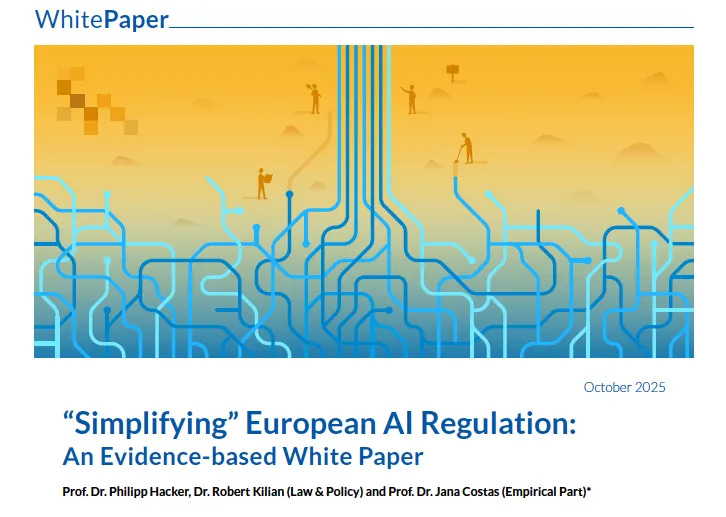
A new white paper, “Simplifying European AI Regulation” (Bertelsmann Stiftung, October 2025), authored by Prof. Dr. Philipp Hacker, Dr. Robert Kilian and Prof. Dr. Jana Costas, calls for evidence-based simplification of the EU’s dense digital rulebook without weakening the AI Act’s protections. Drawing on 15 stakeholder interviews, the study finds that companies—especially SMEs—struggle less with the Act itself than with overlapping, inconsistent rules across EU laws such as the GDPR, MDR and Data Act. The authors recommend a “sector-specific simplification” agenda: clarifying responsibilities along the AI value chain, closing loopholes like post-remote biometric identification, harmonising technical standards, extending implementation timelines, and creating support mechanisms for SMEs. Their conclusion: simplification should mean clarity and coordination—not deregulation—so that Europe can stay both competitive and rights-protective in the AI era.
The EuroHPC JU Selects Six Additional AI Factories to Expand Europe’s AI Capabilities
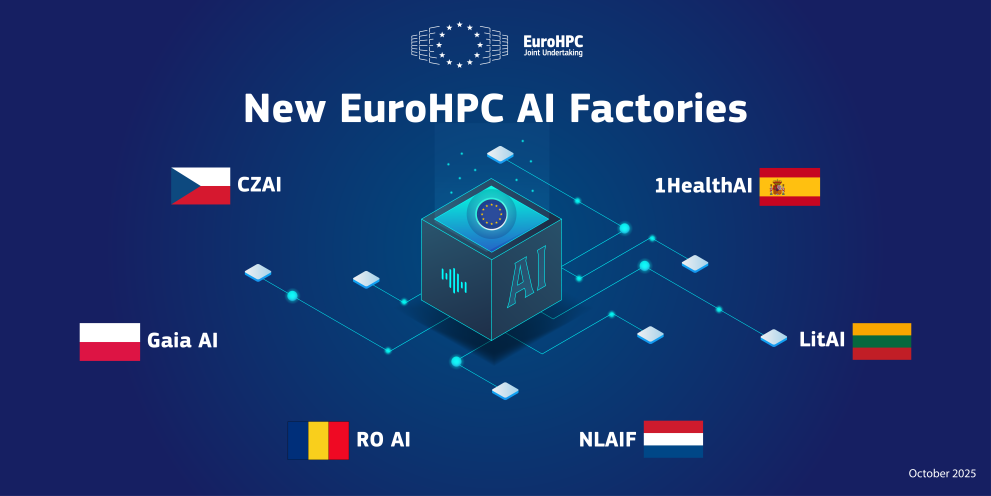
The EuroHPC Joint Undertaking (EuroHPC JU) has selected six new sites to host additional European AI Factories, set to be deployed next year across Europe: in Czechia, Lithuania, the Netherlands, Poland, Romania and Spain.
Apply AI Strategy announced
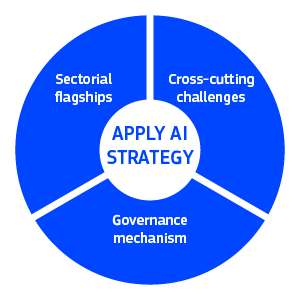
The Apply AI Strategy is the EU’s flagship framework to accelerate AI adoption and reinforce Europe’s technological sovereignty, marking a major step toward establishing the EU as an “AI Continent.” It promotes an AI-first approach, encouraging organisations to consider AI solutions in every strategic or policy decision, while advancing a “buy European” mindset focused on open-source and trustworthy AI. Structured around three pillars—sectoral flagships across ten key industries and the public sector, support measures to boost innovation capacity through AI Factories, Gigafactories, Testing Facilities and sandboxes, and a new governance system centred on the Apply AI Alliance and AI Observatory—the strategy aims to align Europe’s AI ecosystem, empower SMEs, and build an AI-ready workforce to ensure sustainable, competitive, and ethical AI deployment across the continent.
Resource for AI Science in Europe (RAISE) innitiative
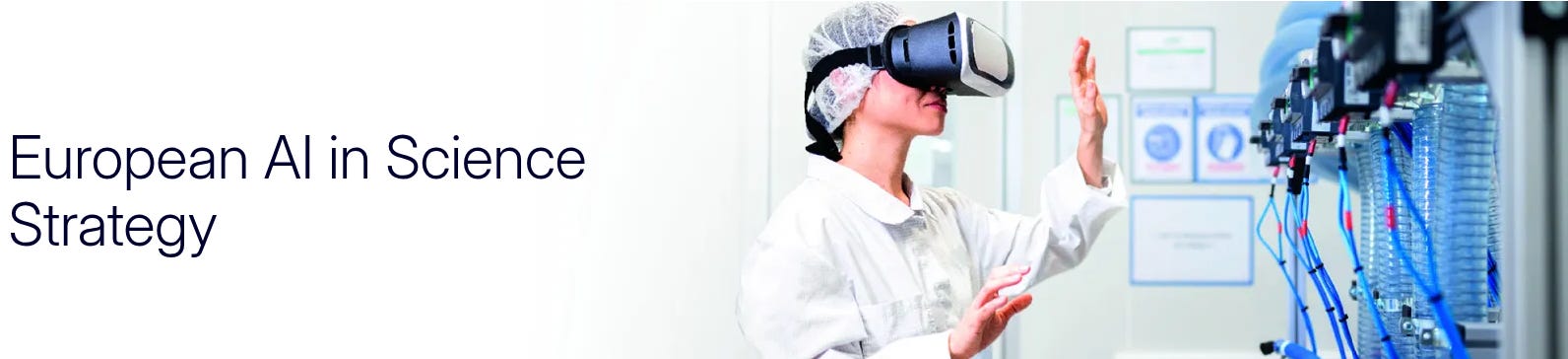
The AI in Science Strategy presents an ambitious approach to advance AI in science through RAISE - the Resource for AI Science in Europe.
RAISE will be a virtual institute pooling talent and resources, including funding, data and compute, to drive excellence in AI research. It will be launched at the AI in Science Summit on 3-4 November 2025 in Copenhagen, together with the Danish Presidency of the Council of the EU.
EC help for AI Act released
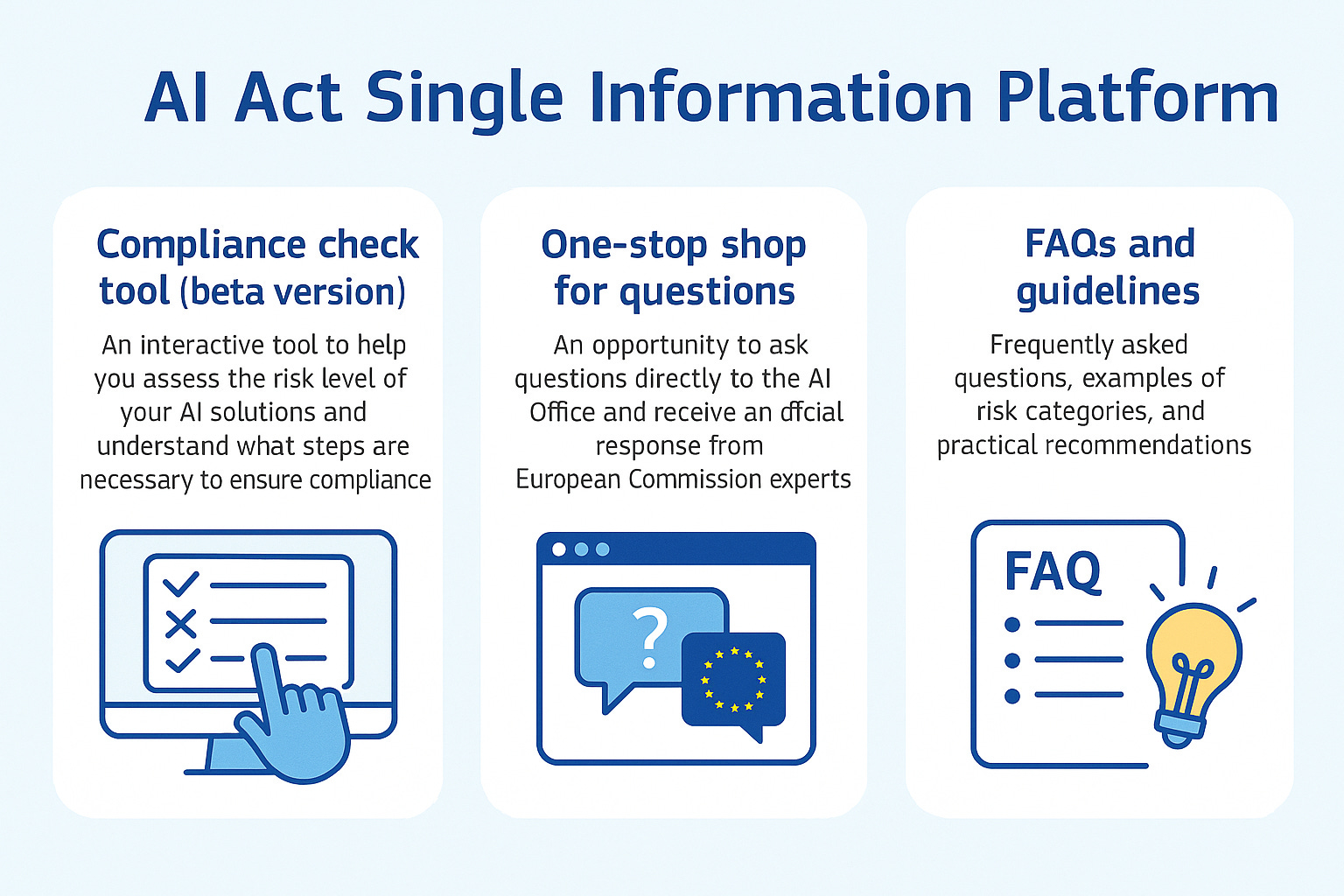
European Commision released help for AI Act preparation:
Compliance check tool (beta version): an interactive tool to help you assess the risk level of your AI solutions and understand what steps are necessary to ensure compliance
One-stop shop for questions: an opportunity to ask questions directly to the AI Office and receive an official response from European Commission experts
FAQs and guidelines: frequently asked questions, examples of risk categories, and practical recommendations
Commission partners with private investors to set up multi-billion Scaleup Europe Fund
On 28 October 2025, the European Commission announced the creation of the Scaleup Europe Fund, a multi-billion-euro initiative developed in partnership with leading private investors to strengthen Europe’s deep-tech ecosystem. As part of the EU Startup and Scaleup Strategy, the fund will provide crucial growth and late-stage capital to Europe’s most promising companies in strategic sectors such as artificial intelligence, quantum technologies, semiconductors, robotics, and autonomous systems. Operating as a market-driven, privately managed and co-financed vehicle, the Scaleup Europe Fund aims to close Europe’s scale-up financing gap, foster technological sovereignty, and ensure that high-potential European innovators can grow and remain competitive globally.
EC on Shaping and strengthening European AI talent
The new report “Shaping the Future of AI Talent in Europe” (StepUp StartUps Consortium, 2025) highlights both the progress and challenges in developing a strong, inclusive AI workforce across the EU. Between 2016 and 2023, Europe’s AI talent pool more than doubled—now accounting for 0.41% of the EU workforce—while AI-intensive sectors like ICT are driving economic growth and job creation. Yet the report warns that by 2030, up to 6.5% of workers may need to transition to new roles as AI transforms industries, deepening skill mismatches. Europe leads globally in AI education, offering 35% of all AI-related master’s programmes, but faces persistent challenges such as gender imbalance (with women comprising less than 25% of AI engineers) and uneven talent attraction across Member States. The study calls for stronger alignment between national and EU initiatives—such as the Apply AI Strategy and forthcoming AI Skills Academy—to ensure Europe not only trains world-class AI talent but also retains it, securing long-term competitiveness and digital sovereignty.
Updates from EAIF member countries
🇦🇱Albania:
Diella, the country’s first AI system that is now a minister in Edi Rama’s cabinet, will have 83 “children,” who will become parliamentary assistants. Link.
🇦🇹 Austria:
Austrian startup newsrooms raises €750K to transform AI-driven content creation. More.
Clearview AI faces criminal complaint in Austria for suspected privacy violations. More
State of AI in Austria 2025: Study shows opportunities and areas of action for companies in Austria. More.
🇧🇬 Bulgaria:
AI “gigafactory” proposal. Bulgaria explored a partnership with IBM and the European Commission to build a national AI gigafactory housing over 100 000 GPU chips. The proposed facility would cost billions, draw up to 500 MW of power and be partly funded by the EU dig.watch.
Education minister urges AI curricula. Education minister Krasimir Valchev told the Youth Economic Forum (6 Oct) that AI will profoundly reshape professions and called on universities to integrate AI into programmes; the government has created an Institute for AI in economics sabanew.net.
Crossroads 2025 conference. Startup Bulgaria’s two‑day event (17–18 Oct) in Sofia drew 3 000 participants, featured an AI hackathon, a startup expo, pitch competitions and 20+ investment funds, making it Southeast Europe’s largest entrepreneurship and investment gathering eurocrowd.org.
INSAIT’s success at ICCV 2025. Bulgaria’s INSAIT institute had 14 papers accepted at ICCV 2025—including an oral and highlight paper—and co‑organised workshops with Stanford and ETH Zurich, positioning Bulgaria as a serious AI research hub insait.ai.
“BrokenMath” highlights LLM sycophancy. INSAIT researchers created a dataset of 504 false theorems and found GPT‑5 produced proofs for false statements in 29 % of cases, demonstrating that large models remain prone to hallucination insait.ai.
GATE’s disaster‑response AI. Sofia’s GATE institute demonstrated AI tools for predicting urban‑heat risk, detecting disinformation and automatically assessing damage during NATO’s emergency exercise gate-ai.eu.
🇨🇿 Czech Republic:
AI supercomputer “KarolAIna”. The European Commission selected a Czech consortium to build a new AI factory. Located in Ostrava, the KarolAIna supercomputer will use about 340 AI chips to deliver 850 petaflops and support research, industry and start‑ups praguedaily.news.
AI supplier database launched. CzechInvest’s National AI Platform created an interactive database of AI suppliers, mapping hundreds of technology providers and noting that 41 % of large Czech firms were already using AI czechinvest.gov.cz.
Czech Startup Week. Held 20–26 Oct, Czech Startup Week showcased technology and innovation, hosting lectures, panels and pitch competitions focused on space and AI start‑ups to attract global investors czechinvest.gov.cz.
Survey shows AI hesitancy. A Prague Daily News survey revealed only 41 % of Czech firms use AI and only 10 % trust AI for strategic decisions; executives cited data‑security concerns and technical failures praguedaily.news.
🇭🇷 Croatia:
Game Changer Zagreb 4.0 (16 Oct). Croatia’s flagship tech conference drew 1 800+ attendees and 110+ speakers across four halls (AI, e‑commerce, gaming & gamification and apps/Gen Z); networking and awards highlighted AI innovation game-changer.tech.
AI in vocational education. Croatia piloted an elective subject “Artificial Intelligence: From Concept to Application” in 53 VET schools, training 1 018 students and covering practical AI skills and ethics cedefop.europa.eu.
Unlock Rijeka 2025. This tech‑festival (16–18 Oct) transformed Rijeka into a digital innovation hub with tracks on AI, marketing and industry trends; more than 100 speakers, including AI specialist Nenad Alajbegović, shared insights luxurylivingcroatia.com.
AI & law workshop. The “Navigating the Future: Law in the Age of AI” workshop in Osijek (9 Oct) explored AI’s legal implications—covering large language models, AI liability, autonomous weapons, labour disputes, tax and consumer rights—and fostered regional collaboration europainstitut.de.
AI2Future 2025 preview (29–30 Oct). CroAI’s AI2Future event in Zagreb promised to cut through AI hype with talks from Arkensight, Porsche Digital Croatia and others, emphasising cross‑industry applications ai2future.com.
🇫🇷 France:
This November 25-26, 2025, the iconic Grand Palais will host the business-focused continuation of the AI Action Summit, led by President Macron alongside Heads of State and Government. More.
“Intelligence(s)” theme for Science Festival. France’s Fête de la Science (Oct 2025) invited citizens to explore different forms of intelligence—human, artificial and animal—prompting reflection on what separates machine and human cognition hongkong.consulfrance.org.
AI in media forum. The WAN‑IFRA Paris AI Forum (28–29 Oct) examined AI agents in media, sustainability, “vibe‑coding”, partnerships, and generative‑AI adoption. It also addressed scraping, content licensing and ethical and sovereign AI wan-ifra.org.
Nvidia to invest up to $1B in French AI startup Poolside as its valuation soars to $12B. More.
AI startup UnifyApps raises $50 million, taps Sprinklr founder as co-CEO. More
Reflection AI, an A.I. Model Start-Up, Raises $2 Billion. More.
🇩🇪 Germany:
Nvidia-Backed AI Startup n8n Raises $180M, Hits $2.5B Valuation. More
German firm Scavenger AI secures €2.5M to simplify data analytics for SMEs. More
ClaimSorted Startup Raised $13.3 Million To Inject AI Into One Of The World’s Slowest Industries. More.
German PropTech startup Arbio raises €31 million to build Europe’s first AI-native platform for holiday rentals. More.
Germany embraces AI, digitization; Trust in generative AI rises. More.
Germany’s AI Startup Landscape 2025: Scaling Intelligence, Sovereignty, and Trust. More.
🇬🇪 Georgia:
Emerging AI startup ecosystem. A September directory spotlighted 22 Georgian AI companies—including STORI AI, Optio.AI, ConsalAi, Helio AI and Virtual Story Studio—signalling a maturing ecosystem f6s.com.
ISET Partners with the Georgian AI Association to Launch Georgia’s First Student AI Club. More.
🇱🇹 Lithuania:
AI talks for CTOs. Knowledge sharing & Networking event organized @ StartupFair, lead by AI leads Vytenis Pakėnas (isLucid) & Tomas Rasymas (Hostinger). More.
AI meetup: “Smarter Security with AI” organized by AI Lithuania association attracted both cyber & AI communities together. More.
On Oct 23 the AI Association of Lithuania, together with Vilnius University’s Faculty of Medicine and the Academy of Sciences, convened a conference on AI in medicine where participants showcased current applications, two Best Young Researcher Awards from the Dr Raslavicius Family Fund went to Gabrielė Tarutytė for deep-learning work on spontaneous abortion risk and Mantas Fabijonavicius for AI‑powered renal cell carcinoma diagnostics. More.
AI meetup: Panevėžys organized by AI Lithuania association event attracted regional researchers from all across Panevezys region. More.
Nexos.ai came out of stealth with an $8 million funding round led by Index Ventures, Nord Security co-founders Tomas Okmanas and Eimantas Sabaliauskas have closed a €30 million Series A (approximately $35 million) co-leading at a €300 million valuation for this new startup — a platform that helps companies adopt AI tools securely by acting as a middleman between employees and AI systems.
🇳🇱 Netherlands:
€200 million Dutch AI factory. The EuroHPC Joint Undertaking awarded funding for a Dutch AI factory in Groningen. The project will cost €200 million and provide a supercomputer and data infrastructure to foster digital sovereignty and AI research aic4nl.nl.
Official launch in historic factory. A ceremony on 16 Oct celebrated the AI factory launch; ministers called computing power “the new gold” and highlighted opportunities in healthcare and law tech aic4nl.nl.
AI education pilots. Saxion University showcased pilot projects such as HAI FIVE (feedback tool for trainee teachers) and sAxI (24/7 chatbot for students). Educators emphasised that AI can enhance learning but must be used responsibly aic4nl.nl.
Court orders chronological feed. A Dutch court (8 Oct) ordered Meta to let users set a chronological feed by default. The ruling—one of the first under the EU Digital Services Act—labels algorithmic feeds as “dark patterns,” promoting user autonomy techpolicy.press.
Cross‑party support for AI factory. Parties from left and right support establishing the national AI factory and emphasise ethics and public values aic4nl.nl
In Netherlands, two far-right members of parliament were found to be behind a Facebook page promoting deepfake images of their left-wing rival ahead of Sunday’s tight election. More.
Dutch start-up Hulo raises €2.3m to advance AI-driven water leak detection. More.
Konekti raises €1.2 million to make data transformation in process intelligence 10x faster. More.
🇵🇱Poland:
ElevenLabs raises $180M Series C to be the voice of the digital world. More
Polish B2B SaaS firm Minerva secures $3M to revolutionize EU public procurement. More.
Warsaw-based SalesPatriot raises €4.2 million to modernise defense procurement and expand into Europe. More.
Polish top-performing language for complex AI tasks, finds study. More
Poland will build second AI factory to boost ‘digital sovereignty’ More.
🇷🇸Serbia:
🇸🇪 Sweden:
Maritime startup Cetasol raises €2.3 million. Swedish company Cetasol secured funding to scale its AI‑powered decision‑support system that reduces fuel consumption in small and mid‑sized vesselss martmaritimenetwork.com.
With $150M in new funding, Swedish AI startup Legora ushers legaltech into the unicorn age. More.
Stockholm-based Vesence has raised $9m as yet AI company comes out of Sweden. More.
Swedish AI startup Grasp raises $7m in series A funding. More.
Can AI Rethink Military Strategy? Sweden and Norway Put It to Test. More.
Have news to share: newsletter@eaiforum.org
Editor: Linas Petkevičius, PhD
Contact: info@eaiforum.org
Website: eaiforum.org
LinkedIn: linkedin.com/company/eaiforum