
EAIF newsletter
European AI Forum (EAIF) newsletter provide you on a monthly basis with insights, news and updates from the European AI ecosystem. AI regulation and EU policy, national AI activities, upcoming events.

In this 2025 November newsletter you can find the following topics:
European Digital Sovereignty in Berlin
France-German AI Associations Formalize Strategic Cooperation
EAIF Position Paper on Digital Omnibus
Adopt AI Summit in Paris
Bielik Summit 2025: A Landmark Event for Polish AI
Commission launches whistleblower tool for AI Act
A code of practice on marking and labelling AI-generated content
Updates from EAIF member countries
Editor's Picks:


European Digital Sovereignty in Berlin
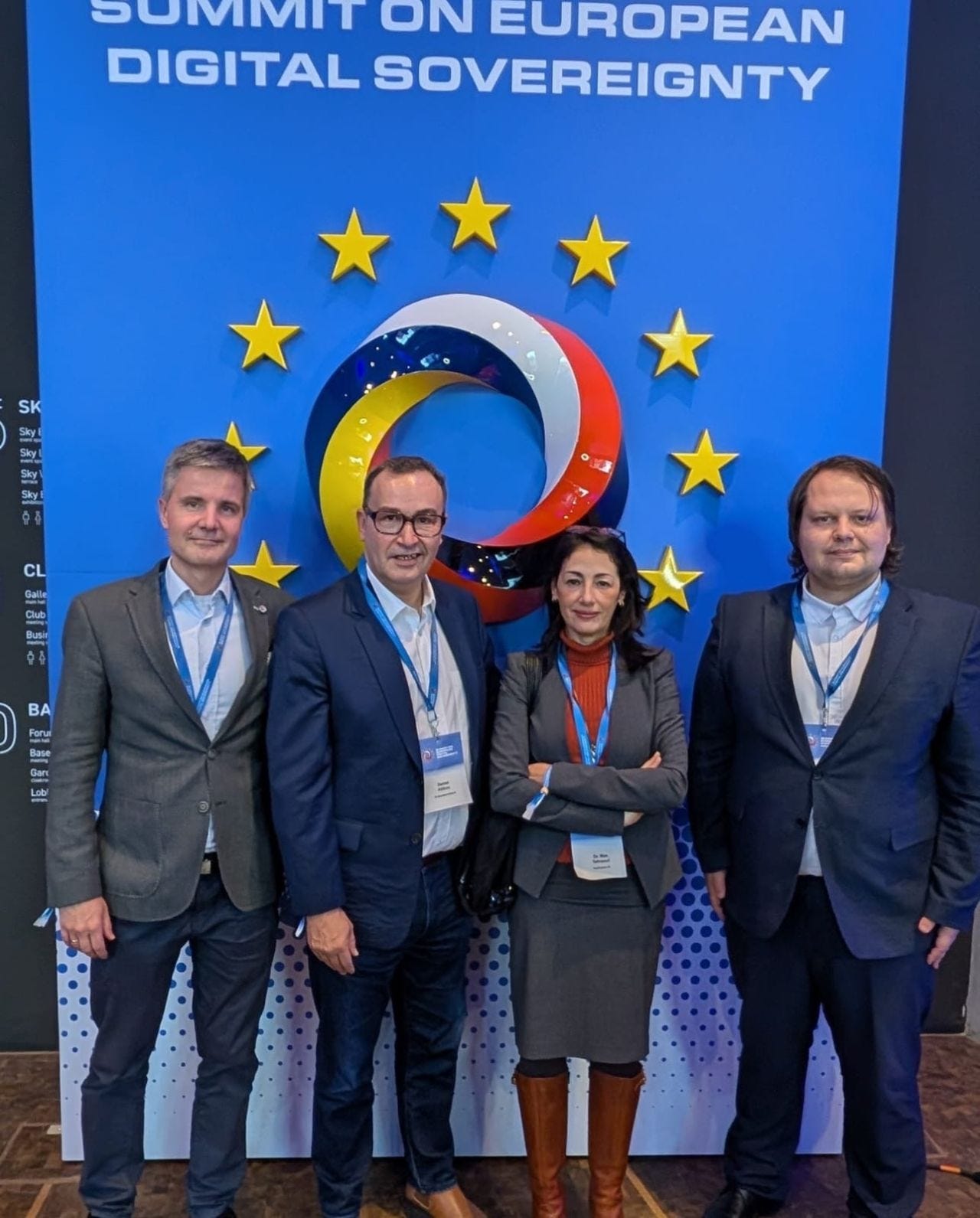
In light of global geopolitical and technological shifts, Germany and France convened the Summit on European Digital Sovereignty on 18 November 2025 at the EUREF Campus in Berlin, bringing together EU partners to strengthen Europe’s capacity for an independent, secure and innovation-driven digital future. The European AI Forum (EAIF) engaged and supported the event, with Daniel Abbou (Germany’s AI Association; EAIF President), Piotr Mieczkowski (Fundacja Digital Poland; EAIF Vice President), Rim Tehraoui (President of Hub France IA) and Linas Petkevičius (President of AI Lithuania; EAIF Board) participating in this event. The main messages were delivered by Chancellor Friedrich Merz and President Emmanuel Macron:
Chancellor Friedrich Merz used his address at the EU Digital Summit in Berlin to argue that Europe must “go its own digital way” and reduce dependence on the U.S. and China. Warning that recent disruptions at major cloud providers and chip shortages show how vulnerable Europe remains, he insisted that “digitale Souveränität hat Kosten, aber die digitale Abhängigkeit hat noch höhere Kosten.” Merz outlined a three-pillar agenda—radical simplification of regulation, strategic investment, and stronger cybersecurity—and announced that Germany will make the state an “Ankerkunde für souveräne digitale Arbeitsmittel” by shifting federal IT procurement toward European solutions. He framed the moment as a continental turning point: “Europa muss in vereinter Kraftanstrengung einen eigenen digitalen Weg gehen… überall dort, wo es notwendig und erreichbar ist.”
President Emmanuel Macron echoed Merz’s urgency, insisting that Europe must no longer be “the client” of American or Chinese tech giants. Digital sovereignty, he argued, is not protectionism but a refusal to become “a vessel” in a global technological power struggle. Macron stressed that Europe must innovate before it regulates: “We may have the best regulations in the world, but we won’t be regulating anything if all the champions are American or Chinese.” He called for a unified digital market, a European preference in public procurement, and rapid adoption of AI across industry, adding that sovereignty must also include protecting “our children, our teenagers, and our democratic space” from opaque algorithms and harmful online content. For Macron, the Franco-German partnership is now the engine: “We strongly believe in a common integrated digital approach… a core team to implement this agenda together.”


France-German AI Associations Formalize Strategic Cooperation
At this year’s Summit on European Digital Sovereignty in Berlin, Germany and France took a decisive step toward a more unified European AI landscape. During a side event at the French Embassy, the KI Bundesverband and Hub France IA formalized a new strategic cooperation agreement—signed by Dr. Annika von Mutius and Managing Director Daniel Abbou on the German side, and by Rim Tehraoui president of Hub France IA. The signing, attended by German Digital Minister Karsten Wildberger and French Ambassador François Delattre, underscores a shared ambition: to deepen Franco-German collaboration as the foundation for a sovereign, innovative and competitive European AI ecosystem. As Abbou noted, the partnership aligns directly with the broader political momentum set by President Emmanuel Macron and Chancellor Friedrich Merz during the summit.
The agreement commits both associations to coordinated representation for a sovereign European AI strategy, joint development of cross-border strategic projects, and strengthened support for AI startups through shared initiatives, improved market access and better pathways to high-performance computing. It also establishes common positions on evolving regulatory frameworks such as the EU AI Act and links the two national ecosystems more closely through regular expert exchange. In parallel, Hub France IA expanded its European engagement by signing additional pro-sovereignty declarations with major French digital organizations and continues its policy work within the European AI Forum (EAIF).
EAIF Position Paper on Digital Omnibus
The European AI Forum (EAIF) has welcomed the European Commission’s new Digital Omnibus draft as a much-needed step toward simplifying EU digital regulation, highlighting its extended deadlines for high-risk AI systems, reduced burdens for SMEs and small mid-caps, and more flexible regulatory instruments. The proposal reflects several long-standing industry demands—including pushing high-risk obligations to 12–15 months and easing registration and documentation requirements—offering AI companies critical breathing room as they wait for still-unpublished harmonised standards needed for full compliance. While EAIF President Daniel Abbou called the draft a “promising proposal,” the organisation warns that high-risk obligations are still scheduled to take effect in August 2026, leaving only months for Council and Parliament to finalise the Omnibus and for companies to prepare amid ongoing uncertainty.


Adopt AI Summit in Paris
The Adopt AI Summit at the Grand Palais in Paris at 25-26 November brought together European industry leaders, researchers, start-ups, and public officials to accelerate the large-scale adoption of artificial intelligence across all sectors of the economy. Positioned as the “Business Edition” follow-up to the global AI Action Summit, the event highlighted the strategic urgency for Europe to master, deploy, and scale AI technologies. Discussions centred on responsible adoption, training, organisational transformation, and the need for trusted, sovereign AI systems. President Emmanuel Macron emphasised that AI is no longer only a technological challenge but a decisive factor for competitiveness, calling for regulatory simplification, major investments in infrastructure, and support for homegrown European technologies to avoid dependence on US and Chinese models.
In his keynote, Macron urged a “massive acceleration” of AI adoption, pointing to France’s growing talent pool, strong start-up ecosystem, and expanding national AI infrastructure — including new data centre capacity and the deployment of the exascale supercomputer Alice Recoque. The Summit also showcased the collective mobilisation of European actors, among them Hub France IA, an active member of the EAIF, represented by Consuelo Innocenti. Through workshops, discussions, and ecosystem engagement, Hub France IA contributed to highlighting concrete use cases and the needs of companies advancing their AI transformation, reinforcing its role in supporting Europe’s ambition to become a global leader in sovereign, trusted, and high-impact AI.


Bielik Summit 2025: A Landmark Event for Polish AI
The inaugural Bielik Summit, held on November 27, 2025, in Warsaw, has firmly established itself as a cornerstone event for the Central and Eastern European Artificial Intelligence (AI) landscape. The summit celebrated the success and future of the Polish Large Language Model (LLM), Bielik, developed by the SpeakLeash Foundation in collaboration with ACK Cyfronet AGH.
The event demonstrated the vibrant interest in Polish-language AI, attracting a massive audience both physically and virtually:
600+ attendees on-site in Warsaw.
300+ participants joining the discussions online.
Knowledge Exchange and Community Building
The day was packed with high-value content, featuring:
A rich program spanning 40 lectures, panel discussions, and fireside chats.
Contributions from over 70 distinguished speakers, researchers, and industry leaders.
Content spread across 3 dedicated stages, ensuring a diverse range of topics from technical deep dives into LLM architecture to ethical considerations and business applications.
Launch of the Bielik Business Council
A significant highlight of the summit was the official announcement and establishment of the Bielik Business Council. This initiative aims to bridge the gap between AI research and practical commercial implementation, ensuring that the Bielik model serves the needs of the Polish economy.
The council was launched with the participation of several key figures from the Polish business and AI communities, including:
Rafał Brzoska, CEO of InPost.
Piotr Mieczkowski, head of AI Poland and VP of European AI Forum.
Magda Dziewguć, CEO, Google Cloud in Poland
Piotr Dorosz, CEO, Deviniti
Katarzyna Starosławska, Bielik (speakleash foundation)
Their involvement underscores the commitment to fostering the development and deployment of sovereign Polish AI solutions across various industries. The successful first edition of the Bielik Summit signals a strong trajectory for the Bielik project and the entire Polish AI ecosystem.

Commission launches whistleblower tool for AI Act
The European Commission launched a whistleblower tool for the Artificial Intelligence (AI) Act. The tool will provide a secure and confidential channel for individuals to report suspected breaches of the AI Act directly to the EU AI Office, the centre of AI expertise within the Commission.
A code of practice on marking and labelling AI-generated content
Under the AI Act, content such as deepfakes and certain AI-generated text and other synthetic material must be clearly marked as such. This requirement reflects the growing difficulty in distinguishing AI-generated content from authentic, human-produced material. These obligations will become applicable in August 2026, complementing existing rules such as high-risk AI systems or general-purpose AI models.
Updates from EAIF member countries
🇦🇱Albania:
AI minister debate – In September 2025 Albania appointed “Diella”, a virtual AI minister. November commentary highlighted skepticism: Social Europe reported that citizens’ trust in public institutions remains low (11.6 %) and that the appointment is seen as symbolic rather than a solution to corruption socialeurope.eusocialeurope.eu. The Western Balkans Info Hub explained that Diella monitors public procurement with human oversight; westernbalkans-infohub.eu. Techstrong.ai noted that opposition parties called the AI appointment “propaganda” and raised legal questions about accountability techstrong.aitechstrong.ai.
AI guidelines for parliaments – The Westminster Foundation for Democracy launched the Albanian‑language version of its Guidelines for AI in Parliaments. The guidelines stress ethical AI use, transparency and aligning AI with good governance wfd.orgwfd.org.
🇦🇹 Austria:
FAIR & AI symposium – TU Graz and the Ludwig Boltzmann Institute for Research on the Consequences of War co‑hosted a “FAIR & AI” symposium. tuwien.at.
Top AI startups - Sifted, has named Emmi AI (Linz), Otera (Innsbruck, formerly DeepOpinion), and Blackshark.ai (Graz) among Europe’s Top 100 AI Startups. The list spotlights fast-growing, independent, B2B AI companies founded since 2018 with valuations below $1B. sifted.eu
🇧🇬 Bulgaria:
EU AI Act discussion and Bulgarian capabilities – In a European Newsroom interview, MEP Eva Maydel said Bulgaria has the resources to develop AI systems tailored to business efficiency. europeannewsroom.comeuropeannewsroom.com.
INSAIT research breakthrough – Bulgaria’s Institute for Computer Science, Artificial Intelligence and Technology (INSAIT) announced StateSpaceDiffuser, a diffusion‑based world model that preserves longer temporal context in video AI. The research, accepted at NeurIPS 2025, demonstrates how a state‑space architecture improves temporal consistency compared with transformer‑based models insait.ai.
🇨🇿 Czech Republic:
Conference on generative AI in journalism – Czech Radio and partners (BBC, Radio France, etc.) hosted a conference on how generative AI is changing journalism. Sessions covered AI tools for news‑gathering, production and delivery irozhlas.cz.
Startup funding – Ranketta – AIN reported that Ranketta, a Czech AI platform builded by 21-year-old Czech AI researcher helping brands improve visibility on AI‑driven shopping sites, raised €1 million from Lighthouse Ventures and Gi21 Capital to expand across Europe and integrate with e‑commerce platforms en.ain.ua
OECD progress note – The OECD’s country note on Czechia highlighted updates to its National AI Strategy. It reported that 93 projects are underway; annual public investment in AI R&D totals around €49–53 million; initiatives like prg.ai Minor and DIGI build skills; and AI hubs (prg.ai and Brno.AI) support startups oecd.org.
🇭🇷 Croatia:
ELIXIR Observer status – ELIXIR (European life sciences infrastructure) announced that Croatia became an observer. A Croatian node led by the University of Zagreb Medical Faculty will focus on human genomics and trustworthy AI/ML, partnering with the universities of Split, Rijeka and Osijek and the Rudjer Boskovic Institute elixir-europe.org.
AI website builder launch – Appy Pie announced the launch of an AI‑powered website builder in Croatia. The platform allows local businesses and tourism operators to create websites without coding and provides localised onboarding openpr.com.
Digital rights report – Balkan Insight summarised BIRN’s digital rights report for Southeast Europe. It noted that AI‑driven deepfakes and voice cloning are increasingly used for fraud and gender‑based violence, and it called for stronger regulation and digital literacy in Croatia and other countries balkaninsight.com.
OECD country note on AI – According to the OECD, Croatia is drafting a national AI strategy and relies on broader digital strategies (“Digital Croatia 2032”). Investments include the Supek and Bura supercomputers and the Vrančić cloud; AI centres (Crobohub++, AI & Gaming EDIH, AI Center Lipik) foster innovation, while education programmes like BrAIn aim to build skills oecd.org.
🇫🇷 France:
Simplification of EU digital rules – Euronews reported that the European Commission, backed by France and Germany, proposed a Digital Omnibus to simplify EU digital rules. French digital minister Anne Le Hénanff supported postponing the high‑risk provisions of the AI Act from Aug 2026 to Dec 2027 to allow companies more time, but critics warned that deregulation could undermine safeguards euronews.com.
Call for multinational AI cooperation – At the Paris Peace Forum, Policy Initiatives Director Adrien Abécassis urged mid‑sized economies to collaborate on frontier AI. The “Blueprint for Multinational Advanced AI Development” argues that countries unable to develop cutting‑edge models or access computing resources risk dependence and that pooling infrastructure, data and talent is necessary for sovereignty parispeaceforum.org
Paris-based NcodiN - a DeepTech startup innovating AI hardware infrastructure, has raised €16 million in Seed funding to enable scalable, energy-efficient computing through its proof-of-concept nanolasers. eu-startups.com
Paris-based biotech company Primaa - which develops AI for automated cancer diagnostics, has raised €7 million in funding from the partnership fund between MH Innov’ and Elaia, and SWEN Capital Partners. vestbee.com
Nationwide Launch of the 500+ AI Ambassadors – Government Initiative
Across the country, more than 500 new “AI Ambassadors” have been appointed to accelerate AI adoption, awareness, and skills development in all French regions. Their mission: strengthen local ecosystems, support the public sector, and help organizations engage with AI responsibly and effectively. dig.watch
🇩🇪 Germany:
Google’s €5.5 billion AI and cloud investment – Euronews reported that Google will invest €5.5 billion to expand its AI and cloud infrastructure in Germany by 2029. Plans include a new data centre in Dietzenbach, expansion of the Hanau campus and larger offices in Berlin, Frankfurt and Munich. The investment is expected to add €1 billion annually to GDP and create 9,000 jobs euronews.comeuronews.com.
Deutsche Telekom & Nvidia industrial AI cloud – Reuters revealed that Deutsche Telekom and Nvidia will build a €1 billion industrial AI cloud in Munich. The platform will host up to 10,000 Nvidia GPUs, allow companies to book computing power for industrial AI applications, and will go live in Q1 2026 reuters.comreuters.com.
Start‑up support & recognition – Germany Trade & Invest reported that the government plans to double start‑up funding to €25 billion through the WIN programme, highlighting AI as a priority. Six German AI startups (tl;dv, Frontnow, N8n, Neura Robotics, Deepset and Fratch) were listed in the Sifted 250 ranking gtai.degtai.de.
octonomy - a Cologne-founded AI company developing agentic systems for complex enterprise support and service workflows, raised around €18.5 million ($20 million) led by Macquarie Capital Venture Capital, with participation from Capnamic, NRW.Bank, and the TechVision Fund. Bringing the company’s total funding to $25 million. eu-startups.com
🇬🇪 Georgia:
DataFest Tbilisi 2025 – The ninth DataFest Tbilisi festival took place with “AI in Focus”. Sessions explored real‑world AI applications, scaling generative AI into workflows and responsible use. kartuliconnect.ge.
FORGE‑AI training programme – As part of the EU‑funded FORGE‑AI project to build a new generation of Georgian AI researchers, a two‑day leadership development training was held (Nov 11–12 2025) at the Muskhelishvili Institute. org.ge
🇱🇹 Lithuania:
AI Meetup: Kaunas brought together the region’s AI community for talks ranging from preference-ranking models and constitutional AI to breakthroughs in ECG synthesis and federated learning for privacy-preserving cardiovascular research. LinkedIn
AI Meetup: Safe AI Forum convened Lithuania’s AI community for an in-depth look at the future of trustworthy and safe AI, highlighting alignment with the European AI Office, emerging safety standards, and upcoming EU AI Act governance frameworks. Featuring expert talks and a high-energy panel discussion, the event showcased Lithuania’s growing leadership in building a safer, more transparent, and forward-thinking AI ecosystem. LinkedIn
Lithuanian Self.co zips €2.56M to expand affordable allergy testing across Europe.
🇳🇱 Netherlands:
AIC4NL investment agenda – The AI Coalition 4 NL presented a national AI investment agenda in The Hague, calling for €5 billion of targeted investments. The plan proposes building AI infrastructure, developing a Dutch AI industry and using AI as an accelerator for transitions in energy, health, nitrogen and food aic4nl.nl.
Blue Magic Netherlands – General Atomics and Dutch ministries hosted “Blue Magic Netherlands 2025” in Eindhoven. The dual‑use innovation & investment conference invited technology and aerospace companies to pitch next‑generation solutions in areas including AI/ML and autonomy ga-asi.com.
Speech on AI and security – At the AI Summit Brainport, Dutch foreign affairs adviser David van Weel said AI is essential for national security and foreign policy, citing its role in Ukraine’s defence. He called for safe acceleration and strategic autonomy, noting that AI is already integrated into the Netherlands’ security policy government.nlgovernment.nl.
Call for an AI Delta Plan – Over 50 Dutch AI experts published an open letter urging the government to launch an AI Delta Plan. They proposed appointing a state secretary for AI, creating flagship research institutes, building a city for self‑driving vehicles and drones, investing billions annually in GPUs and data centres and simplifying regulations, warning that dependence on Chinese or U.S. AI threatens independence nltimes.nlnltimes.nl.
AI start‑up funding – Dutch start‑ups raised capital in late 2025. Partnify (Zwolle) closed a €1.8 million round led by Hi Inov and other investors to expand its AI‑powered partnership‑management platformfinsmes.com. Yasu raised €850 000 pre‑seed funding led by Akka to develop an AI cloud engineer that integrates autonomous agents into Slack and GitHub to detect cloud waste and cut emissions bestbee.com.
🇵🇱Poland:
NG Poland & AI Poland conference – A combined NG Poland, JS Poland and AI Poland conference took place in Warsaw and online. The four‑day event featured workshops on Nov 17, followed by NG Poland (Nov 18), JS Poland (Nov 19) and AI Poland (Nov 20). It allowed developers and technology enthusiasts to explore trends in Angular, JavaScript and AI eventsmaster.pl.
DigitalPoland AI thesis competition – The DigitalPoland Foundation ran a competition for AI‑related bachelor’s and master’s theses. Applications opened on 14 Oct and closed on 14 Nov 2025; winners receive scholarships and mentorships digitalpoland.org.
Polish HRTech startup Global Work AI secures €2 million to enhance automated applications and launch its AI career assistant eu-startups.com
🇷🇸Serbia:
Data Science Conference 2025 – The Data Science Conference (DSC) took place in Belgrade with more than 300 expert talks. It covered AI, machine learning, big data, robotics and AI safety and provided a vendor‑free platform for knowledge exchange data.europa.eu.
Co.Next Day Serbia – The event “Co.Next Day Serbia – Exploring AI Innovations and Securing the Future of IT” in Vrdnik examined rapid AI adoption, IT infrastructure changes and cybersecurity challenges. Speakers from leading vendors discussed AI trends and encouraged networking co-next.eu.
Interactive map of Serbia’s AI ecosystem – Serbia’s Office for IT and eGovernment, with UNDP, launched an interactive map of the national AI ecosystem. The map aggregates data from sources such as the Digital Serbia Initiative, Science Fund and Innovation Fund, classifying organisations by type, technology and geography. Officials said the map supports Serbia’s AI Development Strategy 2025‑2030 and ethical guidelines; the dataset is open and will be regularly updated undp.org.
🇸🇪 Sweden:
Labor Market AI Council report – AI Sweden summarised the first insights report of the Labor Market AI Council. The report found that AI is already widely used in service‑ and knowledge‑intensive occupations but adoption varies by organisational readiness. ai.seai.se.
Swedish AI startup Legora raises $150 million at $1.8 billion valuation. reuters.com
Have news to share: newsletter@eaiforum.org
Editor: Linas Petkevičius, PhD
Contact: info@eaiforum.org
Website: eaiforum.org
LinkedIn: linkedin.com/company/eaiforum