
EAIF newsletter
European AI Forum (EAIF) newsletter provide you on a monthly basis with insights, news and updates from the European AI ecosystem. AI regulation and EU policy, national AI activities, upcoming events.

In this 2026 March-May newsletter you can find the following topics:
Demand for AI Sovereignty Summit
Statement on Europe’s AI Gigafactory programme
Yann LeCun Launches Paris-Based AMI Labs with Record $1B+ Seed Round
Mistral AI Strikes Major Industrial Deals with Airbus & BMW
Cohere Acquires German AI Assets
Updates from EAIF member countries
Editor's Picks:
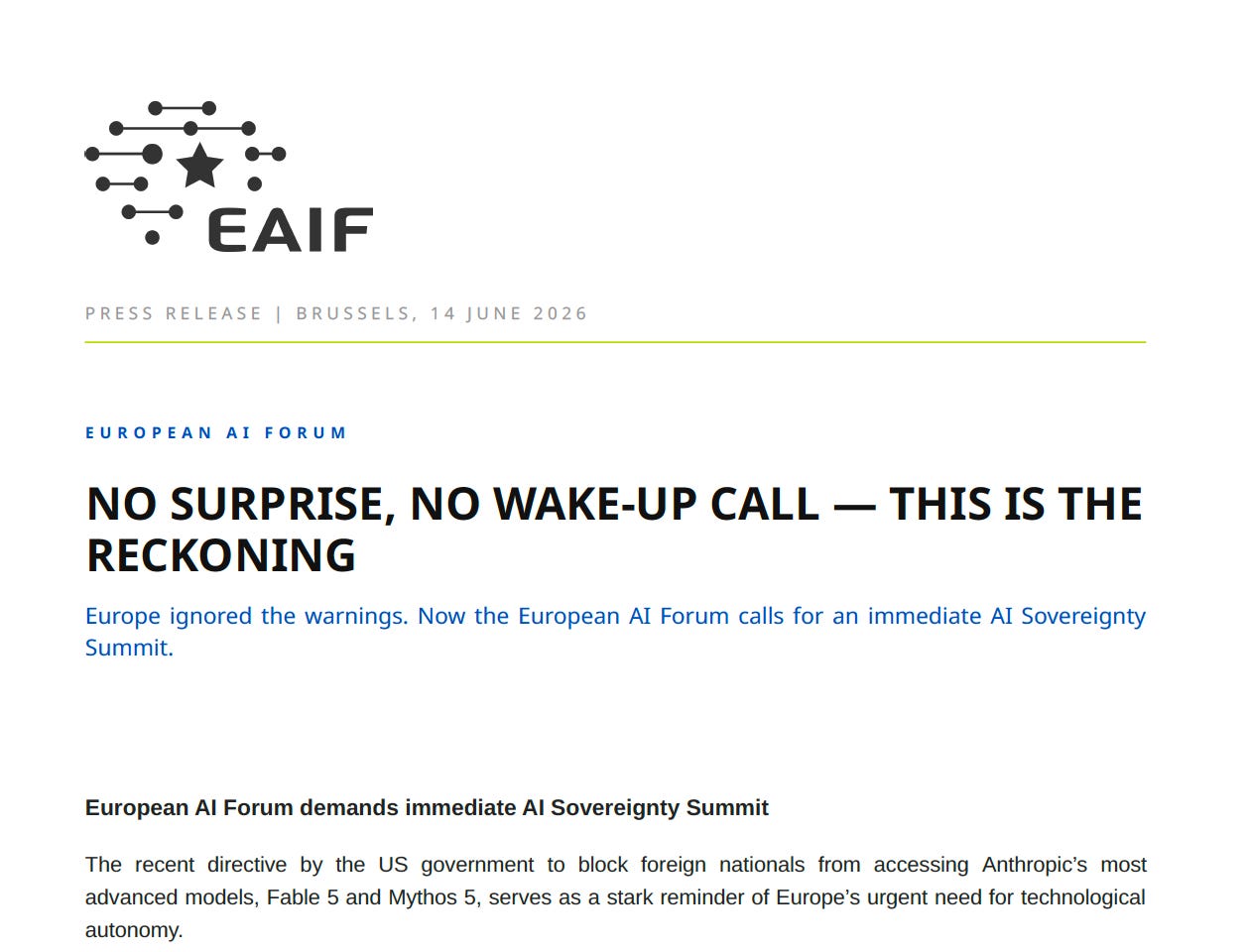
Demand for AI Sovereignty Summit
Europe’s AI dependency problem is no longer theoretical. The European AI Forum argues that the recent U.S. directive restricting foreign nationals’ access to Anthropic’s most advanced models demonstrates how quickly access to critical AI capabilities can be altered by decisions made outside Europe. The organization contends that AI has become strategic infrastructure, comparable to other technologies subject to export controls, and warns that governments, businesses, researchers, and operators of critical infrastructure cannot assume continued access to frontier AI systems developed abroad.
In response, the EAIF is calling for an immediate AI Sovereignty Summit bringing together European institutions, industry leaders, security authorities, and infrastructure operators to create a binding action plan for European AI development. Its proposals include significantly increasing investment in European frontier models, conducting dependency audits across public-sector systems, prioritizing sovereign AI and cloud solutions in procurement, and ensuring sensitive government AI applications remain under European control. The central message is clear: Europe must move from discussing AI sovereignty to actively building it.
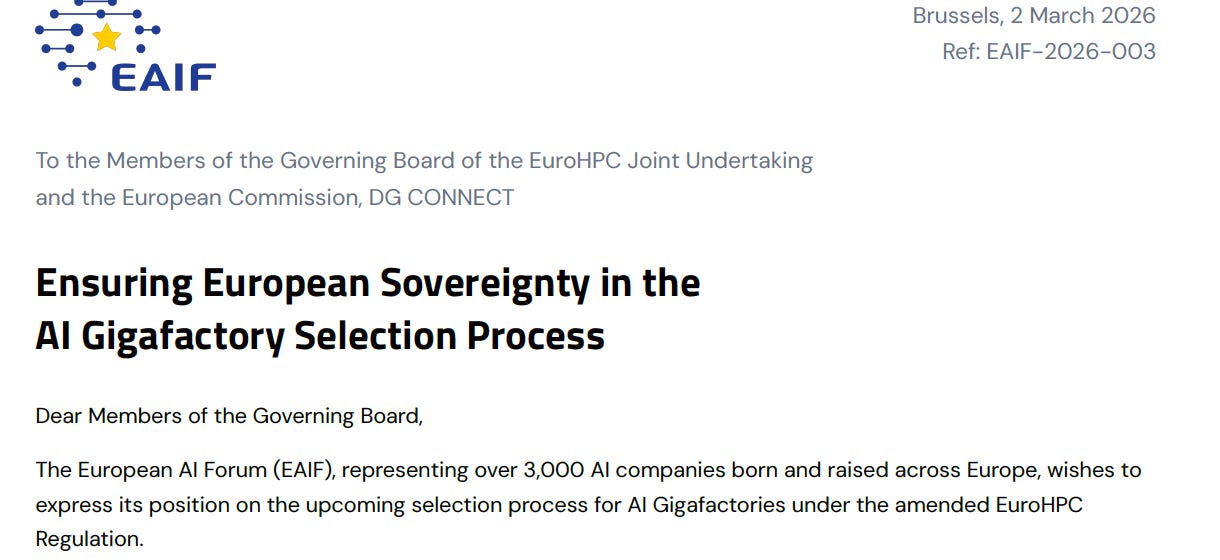
Statement on Europe’s AI Gigafactory programme
Europe’s AI Gigafactory programme is a once-in-a-generation opportunity to build the sovereign computing infrastructure needed to secure Europe’s technological future. In a letter to EuroHPC and the European Commission, the European AI Forum argues that this objective can only be achieved if the selection process genuinely prioritises European sovereignty. Public investment should strengthen Europe’s own AI ecosystem, not create new structural dependencies on non-European hyperscale providers. The Forum therefore calls for rigorous safeguards to ensure that control over Europe’s AI infrastructure remains aligned with Europe’s strategic interests.
The letter also stresses that AI Gigafactories must primarily serve European startups, SMEs and research institutions, while giving Member States greater flexibility in financing participation and making it easier to use existing EU funding mechanisms. According to the Forum, the success of the initiative will ultimately be measured by whether it reduces Europe’s reliance on external providers and creates lasting sovereign AI capacity. If Europe invests billions only to reinforce existing dependencies, it will have missed a historic opportunity to strengthen its competitiveness and technological autonomy.

Yann LeCun Launches Paris-Based AMI Labs with Record $1B+ Seed Round
Turing Award winner and ex-Meta AI chief Yann LeCun founded Advanced Machine Intelligence (AMI) Labs in Paris, raising $1.03 billion (Europe’s largest-ever seed round) at a ~$3.5B pre-money valuation. The startup focuses on “world models” — AI systems that understand the physical world beyond language models, targeting robotics, healthcare, and industrial applications. Backers included Nvidia, Jeff Bezos, Eric Schmidt, and others; offices span Paris, New York, Montreal, and Singapore.

Mistral AI Strikes Major Industrial Deals with Airbus & BMW
French leader Mistral announced partnerships with Airbus (multi-year deal across aviation, defense, space) and BMW (for “Large Industry Model” in engineering simulations/crash testing). It launched a physics-aware AI stack (via Emmi AI acquisition) for industrial applications and advanced its data center/cloud ambitions.

Cohere Acquires German AI Assets
Canadian firm Cohere acquired Germany’s Aleph Alpha (creating a transatlantic sovereign AI player with dual HQ, ~$20B combined valuation) and later Reliant AI (Berlin-based, focused on regulated sectors like biopharma). Supported by German investors (e.g., Schwarz Group) and governments for secure, Europe-friendly AI.
Updates from EAIF member countries
🇦🇱Albania:
Draft AI Law released for consultation (29 May 2026) – Albania published its first AI law draft, aligned with the EU AI Act. It designates AKSHI as the coordinating authority, introduces regulatory sandboxes, SME support measures, and bans manipulative AI practices.
AI-powered public procurement system (Diella AI) announced (11 May 2026) – The government completed technical preparations for an AI-based procurement platform designed to automate registry data collection, reduce bureaucracy, and improve transparency, with World Bank-backed technical groundwork.
AADF–Protik–General Assembly partnership (May 2026) – A three-year initiative was launched to provide advanced training in AI, software development, and EdTech, addressing skills shortages and labor market needs.
🇦🇹 Austria:
AI Factory Austria Coworking Hub launched – The Austrian AI centre AI Factory Austria (AI:AT) opened a coworking hub in Vienna on 24/25 Feb 2026. Government officials and researchers discussed building sovereign AI capacity, access to EuroHPC, and the European AI Factories network. A ministry press release emphasised that AI is one of nine key technologies in Austria’s Industrial Strategy and that the hub will provide training and access to HPC facilities like the Leonardo supercomputer until Vienna’s own facility comes online.
Austria signs AI Leaders’ Declaration – At the India AI Impact Summit in New Delhi (Feb 18‑21), Austria’s Secretary of State Alexander Pröll signed the AI Leaders Declaration. He affirmed a human‑centred approach and international cooperation in areas such as training, inclusion, security and innovation.
Ars Electronica & CARE Austria launch AI for Social Impact Initiative – On 4 Feb 2026, Ars Electronica and CARE Austria announced a program funding interdisciplinary projects that use AI to address social or ecological challenges. Two projects will receive €5 000 each and two €2 500. The initiative emphasises ethical AI development and supports projects in the global South.
AI Tinkerers Vienna community event – On 19 Feb 2026 the AI Tinkerers Vienna meetup brought developers and researchers together to share AI production tips. The agenda included networking and demos on production pipelines, neuromorphic memory architectures and enterprise agent integration.
Nyra Health raises €20 M Series A – Vienna‑based health‑tech company Nyra Health secured €20 million to expand its AI‑driven neuro‑rehabilitation platform. Founded in 2020, it plans to extend across the DACH region and the US.
European funding rounds benefitting Austrian ecosystem – A Vestbee roundup of February funding events lists: Duna (Netherlands) raised €30 M for an AI‑native identity platform; Tytan Technologies (Germany) raised €30 M for defence AI; Bon Vivant (France) raised €25 M for precision‑fermentation AI; Bits Technology (Sweden) raised €12 M for an AI compliance platform. Though not Austrian, these highlight European AI momentum.
🇧🇬 Bulgaria:
Sirma Group dual listing in Frankfurt – On 27 Feb 2026 Bulgarian AI pioneer Sirma Group began trading on the Frankfurt Stock Exchange, completing its dual listing. CEO Tsvetan Aleksiev said the listing increases visibility and liquidity for the enterprise‑technology group. The article notes that Sirma evolved from a Bulgarian startup into a European AI company and that EU companies face challenges catching up with U.S. investment levels.
EU AI Act training by GATE Institute – The GATE Institute in Sofia hosted Bulgaria’s first training on the EU AI Act on 12 Feb 2026. Participants learned about the Act’s scope, risk categories and compliance obligations, and were warned that AI agents can evolve quickly after deployment. Lecturer Ivo Emanuelov stressed continuous compliance and risk management.
Health Ministry drafts plan for AI in healthcare – A draft vision from the Ministry of Health (published Feb 17 2026) outlines phased integration of AI by 2030, focusing on training medical professionals, developing ethical and safety protocols, and establishing a National Fund for Medical AI. The plan calls for human oversight in AI‑supported clinical decisions and aims to improve prevention, diagnosis, hospital management and research.
ManaMind raises funds for AI agents – Bulgarian startup ManaMind sought to raise €1.3 million to develop AI agents that play video games to identify bugs. Founder Emil Kostadinov said the technology saves developers time and could extend to robotics
🇨🇿 Czech Republic:
Czech delegation at India AI Impact Expo – Researchers from the Czech Institute of Informatics, Robotics and Cybernetics (CIIRC CTU) and partners attended India’s AI Impact Expo in New Delhi during mid‑February 2026. Their stand, titled “Czech AI Innovations from the Heart of Europe,” attracted thousands of visitors and showcased AI research. The event was supported by the Ministry of Industry and Trade and aimed to open international cooperation, including an MoU with IIT Roorkee. An affiliated article noted that Zlín region institutions, VSB‑Technical University of Ostrava and startup Neurona Lab also participated.
Funding deals for Czech startups – A February CEE funding roundup lists several Czech AI startups: ValkaAI raised €12 M pre‑seed for an AI‑driven synthetic video platform; Navigara raised €2.1 M seed for engineering team analytics; RobosizeME raised €1.7 M seed for AI workflow automation for hotels; and Neurona Lab (participated in India expo) also secured funding
🇭🇷 Croatia:
India‑Croatia AI cooperation – At the India AI Impact Summit, Indian Prime Minister Narendra Modi met Croatian PM Andrej Plenković. They reviewed bilateral ties and agreed to cooperate in AI, ICT, innovation and clean energy, while working towards an India‑EU free‑trade agreement.
CroAI highlights low AI adoption – Riskoria board member Stjepan Đolonga presented a position paper to Croatia’s National Council for Digital Transformation on 6 Feb 2026, noting that only 12 % of enterprises use AI despite strong innovation rankings. He warned that the EU AI Act requires national regulatory sandboxes by Aug 2026 and urged investment in compute infrastructure and cross‑border access to Slovenian AI factories.
Survey shows Croatians fear AI disinformation – A February survey reported by Riskoria showed that 30 % of respondents identified AI‑driven disinformation as the biggest threat, while job loss ranked last (19.3 %). About 46 % of Croatians use AI tools, mostly at home rather than at work. The survey exposed a generational divide in AI familiarity.
Agentic AI threats explained at NIS Cooperation Group – At the EU’s NIS Cooperation Group meeting on 12–13 Feb 2026, Riskoria CEO Tomislav Vazdar warned that generative and agentic AI tools enable sophisticated phishing and fraud. He explained the perception–reasoning–action–reflection (PRAR) cycle of agentic AI and noted that AI‑assisted phishing now accounts for over 80 % of social‑engineering attacks.
EU AI Act governance gap – Riskoria analysed the EU AI Act’s delayed enforcement, noting that high‑risk provisions will not fully apply until Aug 2027. Croatian Justice Minister Damir Habijan warned that national implementation often takes 5–7 years, creating a governance gap. Riskoria’s experts argued that the three‑year window before full regulation constitutes a security crisis for AI systems.
International Digital Curation Conference (IDCC26) – The 19th IDCC26 conference will take place in Zagreb on 16–18 Feb 2026, exploring how AI, austerity and authoritarianism influence digital curation. The call for participation emphasises ethical issues and sustainable data practices.
Daytona raises €20.4 M – Croatian startup Daytona secured €20.4 million Series A to build agent‑native infrastructure for AI, offering programmable sandboxes for AI agents.
Farseer funding – The CEE funding roundup lists Zagreb‑based Farseer raising €6.1 M Series A for FP&A software using AI forecasting
🇫🇷 France:
India AI Impact Summit – Macron on human‑centric AI – During the summit’s closing session, French President Emmanuel Macron emphasised that the future of AI belongs to those who combine technology with humanity. He praised India for supporting small language models accessible via smartphones and called AI a new frontier in the India‑France strategic partnership.
World AI Cannes Festival (WAICF 2026) – Tech Funding News reported that the WAICF (Jan 12‑13 2026) signalled a shift from AI experimentation to industrial adoption in France. Attendees noted an increase in humanoid robots and that French companies are moving beyond pilot projects to production‑ready solutions. However, despite world‑leading research and startup creation, France still trails in enterprise adoption.
Bon Vivant raises €25 M – According to Vestbee, French food‑tech startup Bon Vivant raised €25 million Series A using precision‑fermentation AI to develop animal‑free dairy proteins.
Black Forest Labs becomes one of Europe’s most valuable AI startups – A Fortune report noted that German visual‑AI firm Black Forest Labs raised $300 million Series B at a $3.25 billion valuation, making it one of Europe’s most valuable AI companies. Although the company is German, it sells widely in France and other countries and underscores Europe’s burgeoning AI ecosystem
🇩🇪 Germany:
Government plans to use AI against organised crime – Germany’s ministries of finance, interior and justice announced plans on 25 Feb 2026 to use AI to fight organised crime. The plan will modernise security bodies, enable data‑sharing among customs and police, and employ AI to identify perpetrators. Ministers emphasised asset confiscation, additional staffing and joint data‑analysis centres.
German AI Market Surveillance & Innovation Promotion Act (KI‑MIG) – On 20 Feb 2026 the government published the KI‑MIG to implement the EU AI Act. A legal briefing explains that supervision will be distributed across sector‑specific authorities (Federal Network Agency, BaFin, etc.) and that organisations must map AI systems to the relevant authority. Product‑safety and data‑protection requirements also apply. A separate article noted that the Federal Cabinet approved the draft law, designating the Federal Network Agency as central AI supervisor and calling for internal classification of AI systems before August 2026.
Robert Bosch Stiftung funds AI for social good – The foundation announced on 25 Feb 2026 that it will provide around €17 million in 2026 for projects that harness digital technologies and AI for social benefit, such as training educators to use AI responsibly and supporting health‑care innovation.
Cognee raises €7.5 M seed – Berlin startup Cognee secured €7.5 million to build a structured memory layer for AI systems and agents. CEO Vasilije Markovic said AI systems often fail because they lack memory, and the funding aims to enable context‑aware AI
Plato raises €12.2 M seed – AI startup Plato raised €12.2 million to develop an AI operating system for wholesale distributors, starting with intelligent sales automation. Investors include Atomico and Cherry Ventures.
6happyhotel raises €6.5 M – Munich‑based happyhotel closed a €6.5 million Series A to develop an autonomous revenue‑management AI agent for hotels, promising to boost revenue by 15 % and support European expansion.
Schwarz Group increases stake in Aleph Alpha – A February report noted that Germany’s Schwarz Group plans to acquire Bosch Ventures’ stake in AI company Aleph Alpha. The investment follows a >€500 million round involving SAP, Bosch and the Schwarz Group; Aleph Alpha will integrate its T‑free model into the Schwarz Group’s STACKIT cloud to deliver sovereign AI services.
Black Forest Labs valued at $3.25 B – Fortune reported that Black Forest Labs raised $300 million Series B at a $3.25 billion valuation, becoming one of Europe’s most valuable AI companies. The company provides open‑source models and supplies technology to many European firms, illustrating Germany’s AI leadership.
🇬🇪 Georgia (Georgian Artificial Intelligence Association):
Georgia AI Readiness Forum (17 April 2026) – Supported by UNESCO, the EU, and PMCG, the forum presented findings from Georgia’s national AI readiness assessment and discussed AI governance, ethics, and future policy development.
Month of AI Initiative (12 March–2 April 2026) – Rainmaking, Startupbootcamp Georgia, TSU, BTU, and partners organized workshops, lectures, and practical AI training sessions across the country.
National AI Olympiad & Talent Development (May 2026) – The Georgian AI Association (GAIA) launched Olympiad preparation programs and conducted the first national selection round on 16 May for international AI competitions.
UNESCO AI Readiness Assessment Recommendations (Spring 2026) – The report identified around 30 AI startups and recommended national AI standards, regulatory sandboxes, stronger governance mechanisms, and improved AI ecosystem data collection.
🇱🇹 Lithuania:
Cast AI Launches Kimchi Coding, an Open-Source Multi-Model Autonomous Coding Agent: Cloud cost optimization leader Cast AI (valued at over $1B) officially launched Kimchi Coding — a terminal-native, open-source autonomous coding agent that uses intelligent multi-model orchestration to assign tasks across frontier and open-weight LLMs based on complexity and cost. In mid-June 2026, Kimchi became the first autonomous coding agent to integrate MiniMax M3 as its default builder model, further boosting performance for enterprise software development.
Women’s leadership in AI emphasised – At the India AI Impact Summit, Lithuanian ministers Edvinas Grikšas and Taurimas Valys led a session on “Women’s Leadership in AI, the Digital Economy and Cybersecurity.” They noted that women comprise 33.4 % of AI professionals in Lithuania (above the global average) and argued that empowering women improves innovation and resilience.
Lithuanian AI startups raise funds – The CEE funding roundup reports that Copla raised €6 M Series A for real‑time compliance infrastructure; Axiology raised €5 M seed for a regulated distributed‑ledger platform under the EU DLT regime; and Tingit raised €1.5 M seed for a digital repair platform with AI features
🇳🇱 Netherlands:
PM Dick Schoof at India AI Impact Summit – Dutch Prime Minister Dick Schoof attended the India AI Impact Summit in New Delhi (Feb 16–20). He emphasised global cooperation in AI and the summit’s theme of “People, Planet, Progress.” The event attracted leaders from around the world.
Funding rounds for Dutch AI companies – An IO+ article summarised February funding events: Axelera AI secured >$250 M for its AI chips, delivering technology to 500 customers worldwide; Duna raised €30 M Series A to offer digital passports for businesses; MicroAlign obtained a €2.5 M European Innovation Council (EIC) grant for quantum fibre arrays; Whispp received €2.5 M from the EIC for AI‑assisted voice reconstruction; and Aizy raised €2 M for AI‑powered marketing optimisation.
Coalition agreement prioritises AI autonomy – AIC4NL summarised the AI section of the Netherlands’ 2026–2030 coalition agreement. It calls for digital autonomy by scaling AI computing capacity with “mega factories,” establishing a Dutch Digital Service, and investing €3–5 billion via a national investment institution. Three pillars include: building sovereign AI infrastructure; supporting pilot‑to‑scale‑up transitions; and applying AI in security, energy, life sciences and agriculture.
Defence joins AI factory – On 18 Feb 2026, partners of the AI factory (AIC4NL, SURF, TNO) met with the Dutch Ministry of Defence. Defence contributed €30 million to explore using the AI factory for defence‑specific applications. The meeting discussed secure handling of sensitive data and Defence will prepare use cases for evaluation.
State of Dutch Tech 2026 report – TNO’s State of Dutch Tech report warns that AI and geopolitical shifts demand urgent action. The Netherlands has high AI talent density (10.9 AI professionals per 10,000 residents), but only 21.6 % of startups become scaleups. About 27 % of venture‑capital investment in 2025 went to AI, with 75 % of that funding from foreign investors.
Responsible AI & Cyber Resilience event – The Hague SecurityDelta hosted an event on 3 Feb 2026 titled “Responsible AI & Cyber resilience for the non‑profit sector.” Non‑profit organisations learned how to manage digital threats and use technology responsibly.
GC REAIM at REAIM 2026 – At the REAIM 2026 summit (4–5 Feb 2026) in The Hague, the Netherlands‑initiated Global Commission on Responsible AI in the Military Domain presented a strategic guidance report and a workshop exploring accountability across the AI lifecycle. More than 40 states endorsed the “Pathways to Action” outcome document.
AI Cup 2026 student competition – TU Delft and partners launched the AI Cup 2026 on 13 Feb 2026. The competition invites students to develop AI solutions for societal or sustainability challenges, judged on both model performance and implementation.
Generative AI, Education & Assessment event – Vrije Universiteit Amsterdam hosted a half‑day event on 6 Feb 2026 examining how generative AI affects education and assessment. The session encouraged educators to share experiences and adapt learning objectives and assessments to AI‑driven environments.
Dutch AI Conference announced – A blog post on 13 Feb 2026 announced the first Dutch AI Conference (scheduled for March 10–12). Supported by sponsors like Elastic, the event aims to showcase practical applications of AI and invite professionals shaping AI’s future.
🇵🇱Poland:
Council of the Future created – TVP World reported that the Polish government formed a Council of the Future in early Feb 2026 to steer long‑term priorities in AI, biotech and space. Commentators warned that such bodies need political support and funding; they noted that tech giants invest more than Poland does and argued that Europe needs unified industrial policies.
Business services sector adopts AI – A Brandsit article based on the Hays 2026 Salary Report reported that 60 % of workers in Poland’s modern business services sector now use AI tools (up from 37 % in 2025). This shift is transforming the sector from low‑cost labour to knowledge work; employers seek specialists in AI, machine learning and cybersecurity rather than general administrative roles.
Large companies benefit more from AI – The Polish Economic Institute’s Economic Weekly observed that 26 % of companies in Poland use AI (11 p.p. below the EU average). Research shows AI implementation raises productivity by ~4 %, but large innovative firms adopt AI faster than small ones. AI is mainly used in marketing, sales and internal processes, and the gap between large and small firms could widen without support.
LLMday Warsaw 2026 – On 12 Feb 2026 the LLMday Warsaw conference brought together around 30 speakers and 150 participants to discuss large language models. The event featured parallel tracks on building and deploying models and highlighted Poland’s growing AI community.
Polish AI startups raising funds – Vestbee’s CEE funding roundup lists several Polish companies: FlyFocus raised €4.8 M seed to develop autonomous drones; Demoboost raised €2.8 M seed for AI‑powered software demos; and other CEE deals illustrate Poland’s emerging AI ecosystem.
🇷🇸Serbia:
SAIFA project launched (14–16 May 2026) – Serbia launched the Serbian Artificial Intelligence Factory Antenna (SAIFA), a EuroHPC-supported initiative connecting Serbian researchers, startups, and companies to European AI and supercomputing infrastructure.
AI Week 2026 & SEE AI Summit (25–31 May 2026) – Serbia hosted one of Southeast Europe’s largest AI event series, including the SEE AI Summit in Novi Sad, bringing together regional AI organizations and resulting in a regional cooperation memorandum.
Public-sector AI modernization call (23 April 2026) – Serbia’s Office for IT and eGovernment invited public institutions to propose AI-powered improvements to government services under the UNDP-supported AI District initiative.
National Serbian-language LLM initiative (April 2026) – Government bodies and research institutions signed a protocol to develop a Serbian-language large language model for public administration, education, and research applications.
🇸🇪 Sweden:
Bits Technology raises €12 M – Vestbee reported that Stockholm‑based Bits Technology closed a €12 million Series A to expand its AI‑driven compliance platform, enabling companies to automate compliance tasks and manage regulatory requirements
Have news to share: newsletter@eaiforum.org
Editor: Linas Petkevičius, PhD
Contact: info@eaiforum.org
Website: eaiforum.org
LinkedIn: linkedin.com/company/eaiforum