
EAIF newsletter
European AI Forum (EAIF) newsletter provide you on a monthly basis with insights, news and updates from the European AI ecosystem. AI regulation and EU policy, national AI activities, upcoming events.

In this 2025 December newsletter you can find the following topics:
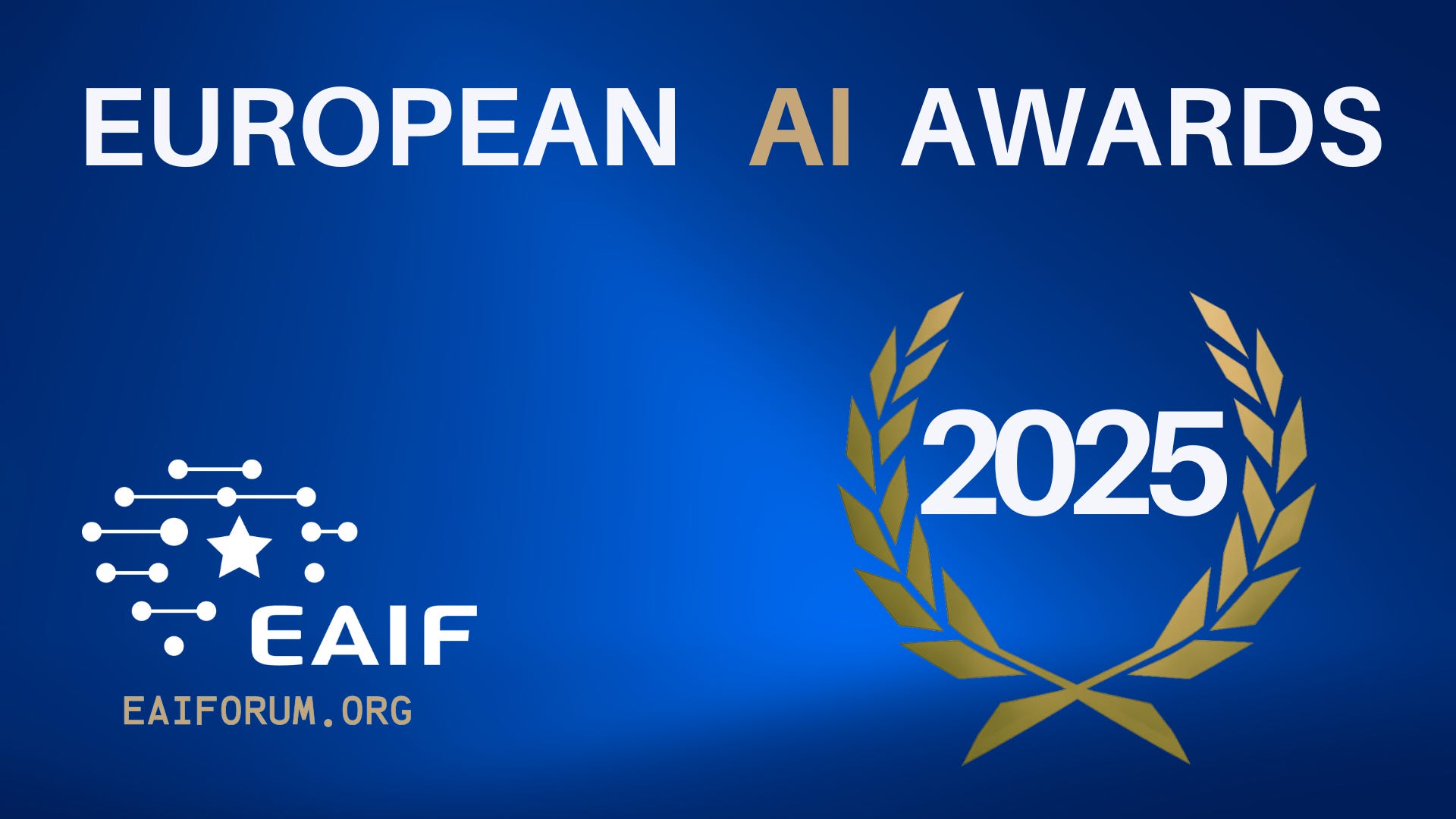
Winners of 2025 European AI Awards announced
EIC puts €1.4 billion to boost Europe’s deep tech innovation
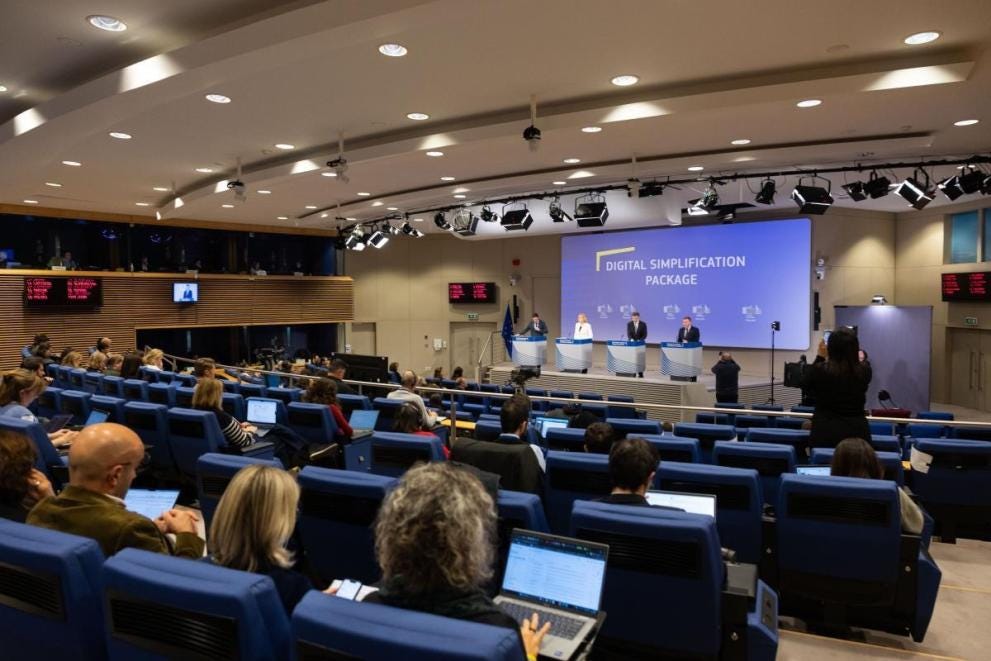
Commission proposes relaxation of AI and data privacy rules to boost technology sector competitiveness
Europe’s Open-Source AI Landscape
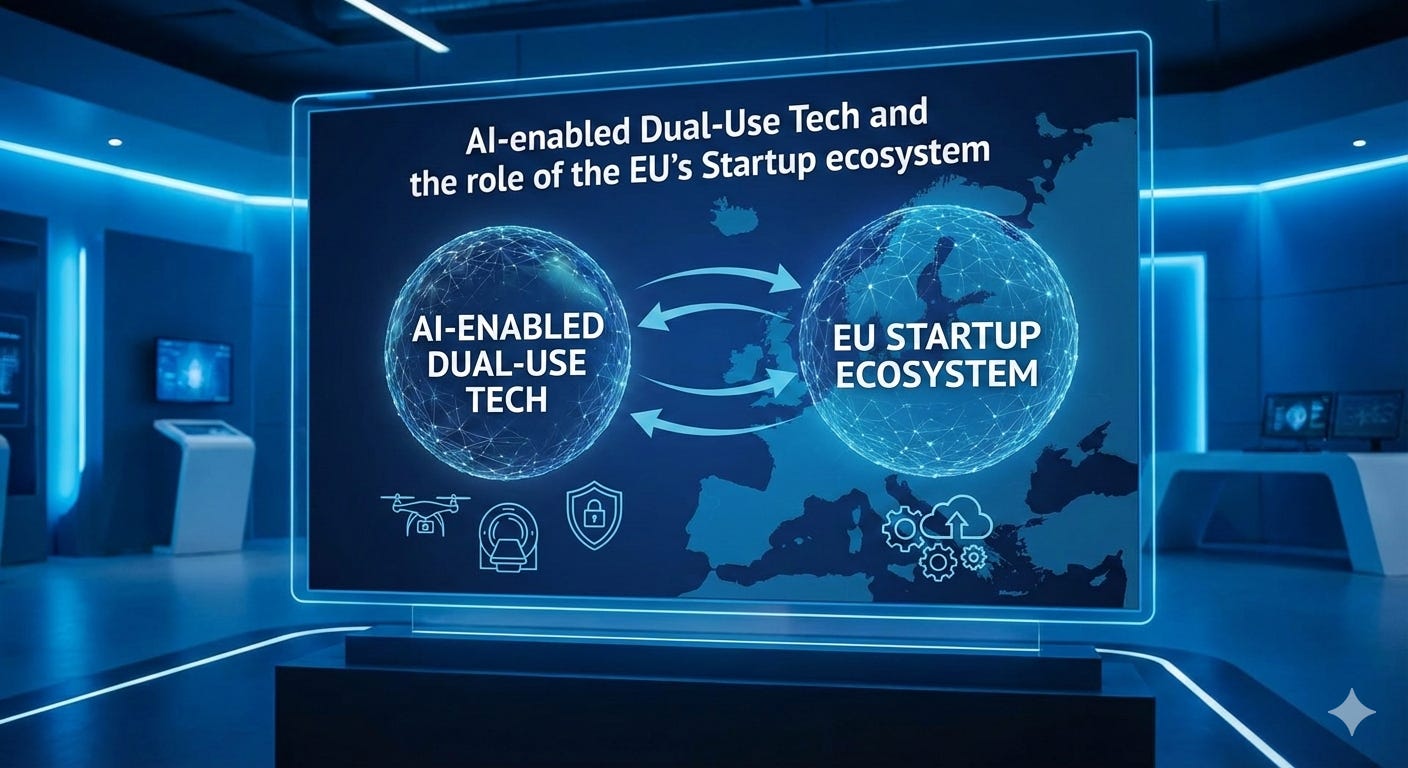
AI-enabled Dual-Use Tech and the role of the EU’s Startup ecosystem
Updates from EAIF member countries
Editor's Picks:
Winners of 2025 European AI Awards announced
The second 2025 European AI Awards organized by EAIF celebrate the breadth and maturity of Europe’s AI ecosystem - from industrial deployment and infrastructure to policy, investment, and applied research.
AI Company:
Cast AI – Optimises AI workloads across Kubernetes and cloud environments, reducing cloud spend and improving performance for AI-intensive applications.
Black Forest Labs – Delivers specialised B2B AI solutions for high-performance computing and autonomous systems in mission-critical industrial settings.
Sort a Brick – Applies AI-driven robotics and computer vision to automate construction waste sorting, boosting recycling rates while cutting costs and emissions.
AI Ecosystem Enablers
European Centre for Medium-Range Weather Forecasts (ECMWF) – Enables trustworthy AI for weather and climate forecasting through open data, shared benchmarks, and operational deployment.
EuroHPC Joint Undertaking – Provides Europe’s supercomputing infrastructure underpinning large-scale AI research and model development.
ELLIS – Strengthens European AI excellence through research networks, PhD programs, and talent retention.
AI Investors
Eurazeo – Backs high-growth European AI scale-ups with long-term capital to build global leaders.
HV Capital – Leads key funding rounds for AI startups with proven business models and cross-industry impact.
Speedinvest – Acts as a first institutional investor for early-stage AI startups, combining capital with hands-on support.
AI Policy Shapers
Axel Voss – Shapes Europe’s data, IP, and digital regulation frameworks affecting AI development and deployment.
Dragoş Tudorache – Co-architect of the EU AI Act, balancing innovation with fundamental rights.
Lucilla Sioli – Leads the implementation of the EU’s AI strategy through concrete programs and infrastructure.
Spinoff & Applied AI Science
Axelera.ai – Develops energy-efficient edge AI processors for real-time, scalable inference.
nomagic.ai – Uses AI-powered robotics to automate picking and packing in e-commerce logistics.
Dronamics – Pioneers long-range autonomous cargo drones for faster and more sustainable freight transport.
EIC puts €1.4 billion to boost Europe’s deep tech innovation
The European Commission has adopted the 2026 work programme of the European Innovation Council, committing €1.4 billion to accelerate Europe’s deep-tech innovators with faster funding, simpler applications, and stronger pathways to customers and investors. The programme sharpens the EIC Accelerator with shorter proposals and bi-monthly evaluations, pilots bold “Advanced Innovation Challenges” inspired by the US ARPA model to back high-risk, high-reward breakthroughs, and aligns with the Startup and Scaleup Strategy to improve access to global markets and track gender participation. Alongside this, the forthcoming Scaleup Europe Fund—privately managed and co-financed under the EIC Fund—aims to close Europe’s late-stage financing gap, helping deep-tech scale-ups grow internationally while staying anchored in Europe, turning world-class research into globally competitive companies.
Commission proposes relaxation of AI and data privacy rules to boost technology sector competitiveness
The European Commission has unveiled a sweeping new digital package designed to cut red tape and help EU businesses—from factories to start-ups—focus more on innovation and growth, with simplification measures projected to save up to €5 billion in administrative costs by 2029 and potentially €150 billion a year through new European Business Wallets. At its heart is a digital omnibus that streamlines rules on AI, cybersecurity, privacy, and data, including a more innovation-friendly rollout of the AI Act, simplified GDPR provisions, modernised cookie consent, and a single cybersecurity incident-reporting interface. Complementing this is a new Data Union Strategy to unlock high-quality data for AI while safeguarding data sovereignty, plus the European Business Wallet, a unified digital identity that will let companies securely sign documents, share verified data, and deal with public authorities seamlessly across all 27 Member States. Together, the package signals a major push by the European Commission to boost competitiveness while upholding Europe’s core standards on fundamental rights, data protection, safety, and fairness.
Europe’s Open-Source AI Landscape
Europe’s open-source AI ecosystem is emerging as a strategic lever for competitiveness, trust, and sovereignty—but the gap with global leaders remains stark. A new EU-funded report shows that while open-source and open-weight models are rapidly closing the performance gap with proprietary AI, Europe still contributes only 5–10% of global open-source models and attracts a fraction of U.S. venture funding. Open-source AI already lowers costs, boosts transparency, and accelerates adoption—especially for SMEs—but limited access to compute, fragmented funding, and slower scale-up continue to hold Europe back. The report argues that with coordinated investment, expanded AI Factories, open-first public procurement, and support for domain-specific, multilingual models aligned with EU values and regulation, Europe can turn open-source AI into its fastest path toward widespread AI adoption and global leadership in trusted AI.
AI-enabled Dual-Use Tech and the role of the EU’s Startup ecosystem
AI is rapidly becoming a decisive enabler of Europe’s dual-use technologies, blurring the traditional boundary between civilian and defence innovation. A new report from the European Commission highlights how AI—while not formally classified as a dual-use technology—now underpins critical capabilities ranging from autonomy, sensing and cybersecurity to logistics and decision-support. Europe’s startup and scale-up ecosystem is central to this shift, translating civilian AI breakthroughs into applications that strengthen competitiveness, resilience and security. The report argues that Europe is entering a pivotal phase: its ability to integrate AI across civil and defence ecosystems will directly shape its technological leadership and strategic autonomy in the years ahead.
The analysis also points to a paradox: Europe’s dual-use AI ecosystem is growing fast, yet remains fragmented. EU programmes such as Horizon Europe, the European Defence Fund and EUDIS increasingly prioritise AI and have improved civil–defence synergies, while hubs like Munich, Berlin, Paris, Helsinki, Tallinn and Vilnius are emerging as centres of strength. Europe now leads globally in the number of dual-use AI investment deals, supported by new defence-focused funds and accelerators. Still, startups face persistent barriers to scale—including limited access to operational test environments, complex procurement, and funding gaps between research and deployment—leaving many innovations stuck at prototype stage. Closing these gaps, the report concludes, will be essential if Europe is to turn its vibrant startup base into a durable advantage in AI-enabled dual-use technologies.
Updates from EAIF member countries
🇦🇱Albania:
AGINC‑2025 conference: The second International Conference on Artificial General Intelligence and Next‑Generation Computing was held in Tirana‑Elbasan. It focused on AGI and scalable AI systems and invited researchers to publish proceedings with Springer icaginc.com.
🇦🇹 Austria:
AI Community Day Vienna: The Global AI Chapter Vienna hosted an in‑person community day at Microsoft Austria. Sessions covered Microsoft AI innovations, building self‑service generative‑AI platforms, Copilot Studio and intelligent agent design. The event, attended by about 50 people, encouraged collaboration and promoted the upcoming AgentCon Vienna event blog.atwork.at.
IAEA symposium on “Atoms for Algorithms”: The International Atomic Energy Agency’s symposium in Vienna gathered over 250 organisations to discuss how nuclear power can meet AI data‑centre demands and how AI can support nuclear technologies. Director General Rafael Grossi called for an “Atoms for Algorithms” alliance; attendees included tech firms such as Google balkangreenenergynews.com.
AI Factory Austria and 42 Vienna partnership: AI Factory Austria announced a collaboration with coding school 42 Vienna. The partnership, launched with an event on 4 December, aims to integrate AI competencies into education and expand training for new digital professions ai-at.eu.
🇧🇬 Bulgaria:
Roundtable on trustworthy AI : The Center for the Study of Democracy hosted a roundtable in Sofia on “Trustworthy AI and Protection of Fundamental Rights”. EU Agency for Fundamental Rights officials and local experts discussed risk‑management frameworks, regulatory sandboxes under the EU AI Act and the need for Bulgaria to develop strategic vision and venture‑capital investment csd.eu.
AgentCon Sofia: Global AI Community’s world‑tour event at Sofia Tech Park featured deep‑dive talks, workshops and networking on AI agents, promoting knowledge exchange among developers globalai.community.
Labour‑market assessment: Bulgarian National Radio quoted HR expert Georgi Parvanov saying AI’s impact on Bulgaria’s labour market remained limited in 2025 but would become more evident in 2026–27; he noted certain craft professions may disappear and young people are not yet fully engaged bnrnews.bg.
Enterprise AI adoption statistics: Eurostat data showed that 8.55 % of Bulgarian enterprises (≥10 employees) used AI technology in 2025, up from 6.47 % in 2024 but still among the EU’s lowest; the EU average was about 20 % sofiaglobe.com.
Survey on AI‑generated content and scams: A Visa‑commissioned survey reported that Bulgarians who mistake AI‑generated content for real are nearly four times more likely to be scammed (58 % vs 16 %); scam victims lost on average BGN 281. The study warns that uncritical trust in AI content increases vulnerability to fraud tps.co.il.
🇨🇿 Czech Republic:
Czech International AI Film Festival (CIAIFF): The festival’s screenings and award ceremony at Cinema City in Prague showcased AI‑driven films and included panel discussions on AI filmmaking. Notifications to filmmakers were sent on 1 December ciaiff.comciaiff.com.
🇭🇷 Croatia:
Green AI data centre: Croatia announced plans to build a “green” AI data centre in the village of Čaporice, Dalmatia. Part of a €20 million energy park, the centre will reuse waste heat for greenhouses, produce biogas from farm waste and promises power‑usage efficiency surpassing Norwegian and Icelandic facilities, with up to 30 % lower user costs dispatcheseurope.com.
NEM Zagreb 2025 (AI & media): The conference in Zagreb explored AI’s role in TV and video. Panels discussed AI as a creative partner in content strategies, real‑time virtual production and European creative sovereignty; participants included broadcasters and telecoms such as RTL Croatia and Nova TV broadbandtvnews.com.
International conference on “Media and the Family in the Age of AI”: More than 100 experts gathered at the Catholic University of Croatia to examine AI’s influence on families and media. Sessions covered generative‑AI tools in education, parental attitudes, ethical aspects, deepfakes and digital literacy unicath.hr.
🇫🇷 France:
AI integration in defence: The French Defence Procurement Agency awarded Airbus Defence and Space a framework contract worth up to €50 million to integrate AI components into the armed forces’ information, communication and cybersecurity systems. The deal supports France’s AI‑for‑defence strategy and aims to deploy AI in systems such as Spationav, ensuring sovereignty over critical technologies airbus.com.
Pending AI bill for copyright: The Ministry of Culture confirmed it is preparing an AI bill that would require generative‑AI developers to secure data access and provide fair remuneration for content used to train AI models. Proposals include reversing the burden of proof in copyright disputes to better protect creators thebookseller.com.
🇩🇪 Germany:
AI in trade fairs study: The German trade‑fair association AUMA released a study showing 70 % of trade‑fair professionals already use AI, mostly for chatbots and marketing automation. The study highlights AI’s potential to personalise visitor experiences and measure success but notes that it cannot replace human interaction auma.de.
“Texpertise Focus AI” initiative: Messe Frankfurt announced that its textile and apparel trade fairs will feature a new programme of panels and demos on AI starting in 2026, reflecting the growing significance of AI in fashion and textiles wtin.com.
Zentio funding round: German startup Zentio raised €1.4 million in pre‑seed funding from High‑Tech Gründerfonds and SIVentures to develop AI‑native production‑planning software for factories. The funds will help strengthen its optimisation systems and machine‑learning pipelines vestbee.com.
🇬🇪 Georgia:
GIU Annual Scientific Conference: Georgian International University hosted a conference titled “Artificial Intelligence and Trends in Digital Transformation”. Tracks covered ethics and AI, data protection, national security, digital entrepreneurship and mental health, with participants receiving bilingual certificates giu.edu.ge.
DataFest Tbilisi reflection: An article on OC Media highlighted reasons to attend November’s DataFest Tbilisi, emphasising sessions on AI breakthroughs, generative design, ethics and responsible AI. It noted key partners such as the Georgian AI Association and underscored the festival’s role in cross‑disciplinary AI collaboration oc-media.org.
🇱🇹 Lithuania:
European Language Data Space workshop – 4 Dec 2025: The LDS country workshop in Vilnius brought together industry, government and researchers to discuss how language data enables AI tools. Sessions highlighted the need for high‑quality language data and included a panel moderated by AI Lithuania’s president language-data-space.ec.europa.eu.
GameTech program milestone – 19 Dec 2025: Startup Lithuania celebrated the third edition of its GameTech program, which provided more than 1,000 hours of mentoring, held 24 events and offered €1 million in grants to local game studios. The initiative demonstrates how targeted support can build a thriving digital‑and‑AI ecosystem startuplithuania.com.
Plug and Play accelerator results – 10 Dec 2025: Startups from the Plug and Play accelerator raised more than €8 million. Over 1,000 applicants – including AI, biotech, fintech and dual‑use technology firms – joined the programme, reflecting a startup ecosystem now valued at over €15 billion and generating high‑skilled jobs and exports startuplithuania.comstartuplithuania.com.
🇳🇱 Netherlands:
Energy‑efficient AI strategy: Invest‑NL and ROM Netherlands released a study urging the Netherlands to invest €20–30 million in software and over €100 million in hardware for energy‑efficient AI. The report argues that the country should leverage high‑quality industrial data and robust infrastructure to develop privacy‑friendly edge AI rather than chasing huge language models; it proposes exploring a national “AI gigafactory” hollandhightech.nlhollandhightech.nl.
Government‑wide Monitor on Generative AI: The Dutch government published its first monitor tracking 81 generative‑AI applications across public‑sector organisations (up from 8 a year earlier). TNO recommended focusing on societal challenges, involving experts and end‑users, assessing long‑term impacts, promoting reusability, strengthening procurement, addressing digital dependencies and allowing time for impact assessments nldigitalgovernment.nl.
AI Coalition 4 NL year‑in‑review: The coalition highlighted that its Agenda 2025–2027 advocates for a €5 billion national AI investment agenda. It announced new innovation labs and learning communities, the Breaking Barriers support programme for AI startups, and its role in shaping public debate and working with the National Growth Fund aic4nl.nlaic4nl.nl.
Blue Magic Netherlands 2025: GA‑ASI’s second “shark‑tank”‑style event in Eindhoven allowed 16 Dutch companies to pitch technologies in AI/ML, autonomy, sensors and advanced materials to investors and partners such as the Ministry of Economic Affairs and Lockheed Martin. More than 350 attendees participated ga-asi.com.
AI adoption survey: An NL Times report noted that one in six Dutch companies use AI (double the 2023 figure). Adoption is highest in large firms (66 %) and is mainly used for marketing (35 %), administrative tasks (32 %) and research or innovation (25 %); 73 % of non‑users cite lack of experience as a barrier.
Generative‑AI governance guidance: TNO announced it is developing practical pathways to help organisations move from reactive “fire‑fighting” to proactive control of generative‑AI governance, emphasising responsible and safe deployment tno.nl.
🇵🇱Poland:
Government complaint about AI‑generated disinformation: Poland’s deputy digital affairs minister Dariusz Standerski asked the European Commission to investigate TikTok after AI‑generated videos calling for Poland to leave the EU appeared. He warned that the content was likely Russian disinformation and urged enforcement of the Digital Services Act’s AI‑risk‑assessment obligations reuters.com.
Detailed context on Polexit videos: Notes from Poland reported that the disinformation campaign involved a channel originally named “Poland without EU” (later “Prawilne Polki”); officials said the AI‑generated videos threaten public order and requested EU intervention notesfrompoland.com.
Shaping Tomorrow: Artificial Intelligence & Digital Healthcare conference: The Polish Association of Hospital Directors hosted a conference in Kraków exploring how AI and digital solutions are redefining hospitals. Sessions covered AI in patient care, data interoperability, cybersecurity and legal regulations, attracting healthcare managers and executives dyrektorzyszpitali.orgdyrektorzyszpitali.org.
Python Summit 2025: Held in Warsaw (online on 4 Dec and in person on 5 Dec), the summit featured over 50 talks across tracks including data science, AI, machine learning and data engineering, plus networking events and an after‑party pythonsummit.orgpythonsummit.org.
eQualPRO conference: In Bydgoszcz, trade unions, public institutions and experts met to discuss gender equality in the digital age. Debates looked at how digitalisation and AI can both advance and endanger women’s rights, calling for inclusive policies and social dialogue cesi.org.
EU AI gigafactory funding revision: Deputy Minister Standerski told European Newsroom that the European Commission plans to run a Europe‑wide tender for AI gigafactories instead of member‑state consortia. He said Poland remains committed to the Baltic AI gigafactory (with Lithuania and Czechia) but new rules may require member states to fund 17.5 % of costs upfront europeannewsroom.com.
🇷🇸Serbia:
Government AI Readiness Index: Serbia ranks among the top 20% of the world’s most prepared economies for artificial intelligence. b92.net
🇸🇪 Sweden:
AI@KI event: Karolinska Institutet’s “Advances in Artificial Intelligence” event in Stockholm featured sessions on AI‑based cancer and infectious‑disease screening, multimodal data integration for psoriasis, and machine‑learning models predicting treatment outcomes in rheumatoid arthritis. The day concluded with a prize ceremony for the Advances in AI award ki.se.
NordForsk responsible‑AI projects: NordForsk selected 17 projects on responsible AI, sharing NOK 300 million. Twenty‑nine Swedish researchers from eight universities participate, focusing on ethical and trustworthy AI development vr.se. Forte later emphasised Swedish leadership in these projects forte.se.
New national centre to protect AI systems: Linköping University announced it will host a national centre to make AI systems resilient against cyberattacks. Funded by SEK 60 million from the Swedish Foundation for Strategic Research, the centre will be led by Professor Fredrik Heintz liu.se.
Have news to share: newsletter@eaiforum.org
Editor: Linas Petkevičius, PhD
Contact: info@eaiforum.org
Website: eaiforum.org
LinkedIn: linkedin.com/company/eaiforum